


Choosing the right spring rate is key to enhancing performance in various applications. First, we need to understand Hooke’s Law, which helps us calculate the spring rate based on force and displacement. Next, we consider material properties that affect flexibility and stiffness, as well as environmental factors like temperature and corrosion resistance. Finally, balancing the number of active coils optimizes load distribution. If you stick with us, we’ll explore more tips for selecting the perfect spring!
Key Takeaways
- Determine the application’s load requirements by calculating the maximum weight the spring must support without permanent deformation.
- Use Hooke’s Law (k = F ÷ x) to find the desired spring rate based on applied force and displacement.
- Consider environmental factors such as temperature and humidity to select materials with appropriate corrosion resistance and thermal stability.
- Assess the required balance between stiffness and flexibility to ensure optimal performance without sacrificing shock absorption or rigidity.
- Factor in the number of active coils to adjust the spring rate, ensuring it aligns with specific performance and load distribution needs.
Understanding Spring Rate Basics
When we talk about spring rate, we’re diving into the fascinating world of how springs work. The spring rate represents the stiffness of a spring, measuring the force needed to compress or extend it by a unit distance. It’s also known as the spring constant (k). A higher spring rate means a stiffer spring, requiring more force for the same deflection, while a lower spring rate indicates a more flexible spring. These mechanical properties are vital because they determine how much energy the spring can store under load. For example, softer springs are great for comfort in mattresses, while stiffer springs are essential for vehicle suspensions. Understanding these basics helps us choose the right spring for any application! Additionally, shock absorbers play a crucial role in how effectively a spring performs in applications like RC car suspensions.
Calculating Spring Rate Using Hooke’s Law
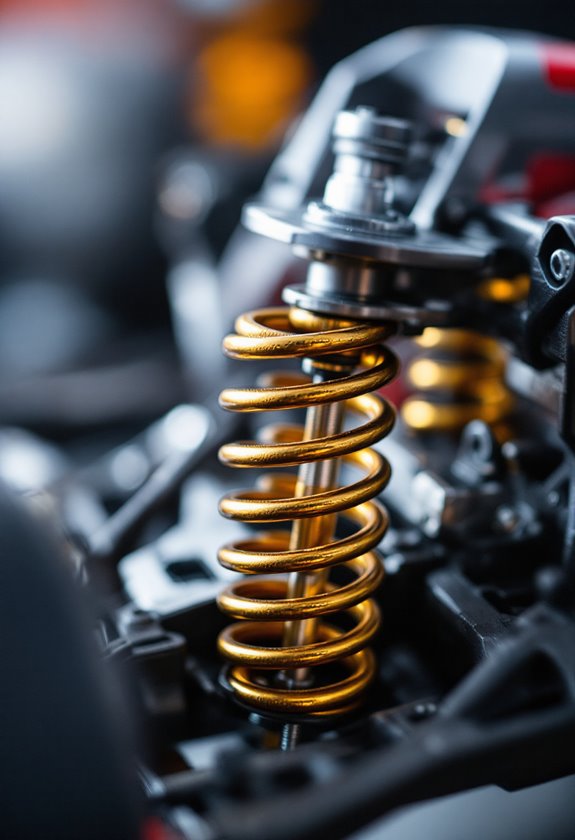
Calculating spring rates using Hooke’s Law is essential for anyone looking to understand how springs operate in different applications. At its core, Hooke’s Law tells us that the force required to compress or extend a spring is directly proportional to the distance it’s stretched or compressed. We calculate the spring rate, or constant (k), by using the formula k = F ÷ x, where F is the applied force in newtons and x is the displacement in meters. For accurate results, we must measure both force and displacement carefully. For instance, if a force of 2,450 N compresses a spring by 0.5 m, we find the spring rate is 4,900 N/m. Understanding these calculations enables us to make informed decisions about spring applications! Additionally, choosing the right spring stiffness is crucial for achieving optimal vehicle performance and handling on various terrains.
Factors Influencing Shear Modulus
Understanding spring rates is just one aspect of the fascinating world of materials and their behavior. Several factors influence shear modulus, which measures a material’s resistance to shear deformation. For instance, shear resistance varies based on material orientation; for example, wood behaves differently when forces are applied parallel or perpendicular to its grain. The crystal structure also plays a crucial role, as certain arrangements dictate how easily a material can deform. Additionally, temperature variations and thermal expansion can reduce shear modulus, creating challenges in hot environments. Finally, the microstructure effects, including grain size and phase distribution, along with the presence of alloying elements, can enhance or diminish shear properties. Recognizing these factors is essential for successful material selection, and understanding adjustable shock compatibility can further optimize performance in RC vehicles.
Material Properties and Their Impact
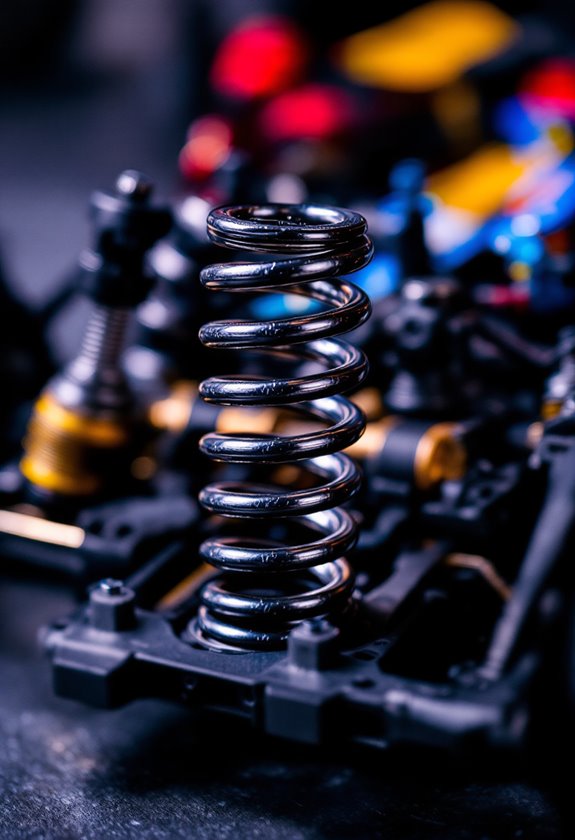
Material properties play an essential role in shaping the performance and effectiveness of springs in various applications. When we discuss material elasticity, we immediately see that it has a direct impact on spring rate. For instance, a higher modulus of elasticity results in a stiffer spring, which can resist compression or extension more effectively than its counterparts. However, we must also consider manufacturing variations; these can lead to differences in shear modulus, which typically ranges between 11,200,000 PSI and 11,900,000 PSI for carbon steel. These variations affect our spring rate calculations and force outputs. As a result, selecting materials with consistent properties becomes vital for ensuring reliable spring performance, helping us achieve the desired characteristics while mitigating risks associated with material inconsistencies. Additionally, the quality of materials used in other components, such as drivetrains, can also influence overall system performance.
Load Capacity Considerations

Load capacity plays a significant role in determining how springs function within various applications. Understanding load performance is essential for making certain that a spring operates safely and effectively. We need to remember that the maximum load a spring can handle without permanent deformation is its working load limit. This limit is influenced by factors like solid height and material properties, so over-compression can lead to damage. Calculating the proper spring rate through the force-to-displacement relationship helps us stay within elastic limits, maintaining spring stability. We should also consider load distribution across mounting points to guarantee effective performance throughout the spring length. By paying attention to these aspects, we can enhance both safety and load capacity in our spring applications. Additionally, spring stiffness ratings are crucial for ensuring the appropriate handling and responsiveness of the vehicle.
Performance Requirements for Springs
When we think about spring performance requirements, it’s essential to focus on how springs will be used in specific applications. Understanding spring rate and stiffness is important, as these factors define the force needed to compress or extend a spring. For effective spring testing, we must conduct load analysis to verify the spring can handle the required weight without permanent deformation. Additionally, we should consider fatigue cycles, which impact longevity and material selection. Environmental factors, such as temperature and corrosion resistance, also play a significant role in choosing materials. By examining these performance criteria, we can verify the springs will meet the demands of their applications and provide reliable, consistent performance throughout their lifespan. Moreover, selecting high-quality materials enhances longevity and reliability in spring manufacturing is crucial for optimal performance.
Evaluating Spring Geometry and Dimensions
Spring geometry and dimensions are essential to ensuring our springs perform accurately and reliably in their intended applications. When we evaluate spring geometry, we must consider how the outer diameter (OD), inner diameter (ID), and wire diameter work together. For instance, knowing that OD equals ID plus two wire diameters helps in our calculations. The dimensional tolerances we set can greatly affect how the spring fits into our design. Free length and coil space also play critical roles, influencing how much force our springs can produce. By carefully evaluating these dimensions, we can improve load capacity and overall performance. Remember, proper measurements today lead to successful springs tomorrow. Let’s get calculating!
Importance of Wire Diameter and Outer Diameter
In our pursuit of high-performing springs, understanding the importance of wire diameter and outer diameter is key to achieving ideal results. The wire diameter considerably influences the spring rate; as we increase it, the spring becomes stiffer, enhancing load capacity. Notably, even small changes in wire diameter can create large effects due to its fourth power relationship in the spring rate formula. On the other hand, the outer diameter shapes our spring’s fit within applications. A well-chosen outer diameter guarantees proper clearance and functionality, while affecting how the spring compresses and extends under load. Finding the right balance between wire diameter and outer diameter is vital, guaranteeing the springs we create meet our performance needs effectively.
Free Length and Active Coils Overview
Understanding free length and active coils is vital for anyone looking to optimize spring performance. When we talk about free length measurement, we’re referring to the height of a spring when it’s not compressed. This measurement is essential for determining how much a spring can deflect under load. Now, let’s explore active coil characteristics. The active coils are the ones doing the heavy lifting, contributing to deflection and load capacity. We calculate active coils by subtracting the inactive coils at the ends, which don’t contribute to the spring rate. More active coils mean lower spring stiffness, allowing easier bending. Ultimately, grasping these concepts helps us choose the right spring for our needs and guarantees the best performance in our applications!
Environmental Impacts on Spring Selection
When selecting the right spring, we can’t overlook the significant impact of environmental factors on performance. Temperature resistance is key, especially in high-temperature settings; we need materials like stainless steel or non-ferrous alloys. We should also consider chemical compatibility, as harsh chemicals can degrade spring materials and compromise their integrity. Moisture exposure is another important factor; high humidity can lead to corrosion, so protective coatings might be necessary. It’s essential to conduct thorough environmental assessments and consider fatigue considerations and vibration impacts to guarantee longevity. Each of these factors helps us choose springs that not only fit our needs but also thrive in their intended environments, enhancing their performance and durability over time.
Handling Corrosion Resistance
Handling corrosion resistance is essential for ensuring the longevity and reliability of springs in various applications. We need to take into account corrosion prevention strategies that suit the specific environmental factors our springs will encounter. For instance, choosing stainless steel or copper-based alloys can offer excellent protection against harsh conditions. However, if we’re using carbon steels like spring steel, protective coatings and surface treatments are critical to enhance their resistance. It’s important to factor in humidity levels, temperature variations, and exposure to corrosive substances like salts or acids, as they can accelerate deterioration. By prioritizing the right materials and treatments, we can markedly reduce the risk of corrosion, ensuring our springs perform reliably over time in various conditions.
Applications Requiring Specific Spring Configurations
In various applications, the need for specific spring configurations can greatly impact performance and stability. For instance, when we mount springs at angles, we have to take into account angular corrections to maintain their effectiveness. A 10° angle requires a correction factor of 0.981, while a 30° angle reduces the effective rate to 0.873. It’s also important to factor in motion ratios, especially with varying systems like double wishbone suspensions and MacPherson struts. If we have a 1.1:1 motion ratio, we need to multiply the spring rate by the motion ratio squared to achieve the desired wheel rate. Paying attention to these specific configurations can dramatically enhance our vehicles’ handling and safety, especially in racing or performance contexts.
Achieving Optimal Balance Between Stiffness and Flexibility
Achieving the right balance between stiffness and flexibility in springs is essential for ideal performance in any application. We need to guarantee that our springs possess the right spring flexibility, providing shock absorption, while maintaining enough rigidity for support. If we choose springs that are too stiff, we risk limited motion and increased vibrations, leading to discomfort and component stress. On the other hand, overly flexible springs might bottom out under load, failing to support the system effectively. By carefully considering stiffness balance, we can customize our springs, adjusting the number of active coils to distribute loads evenly. This way, we enhance performance and extend longevity, making our systems more reliable and efficient for various applications.
Frequently Asked Questions
How Does Temperature Affect Spring Performance?
Temperature considerably impacts spring performance; as it rises, we see thermal expansion altering stiffness and flexibility. For ideal thermal stability, we must consider these effects to guarantee our springs maintain functionality across varying conditions.
Can a Spring Lose Its Rate Over Time?
Yes, springs can lose their rate over time due to spring fatigue and material degradation. As cycles accumulate, the spring’s stiffness diminishes, affecting its overall performance and load capacity in the long run.
What Is the Impact of Spring Coating on Performance?
We’ve found that different coating types considerably enhance spring materials’ performance. They improve corrosion resistance, reduce friction, and increase tensile strength, ultimately leading to longer-lasting springs and better operational efficiency for various applications.
How Do I Determine the Appropriate Spring for My Application?
To determine the appropriate spring for our application, we can analyze a case where a manufacturing robot needs precision. Considering our load requirements, we’d select a compression spring type that meets both stiffness and deflection needs effectively.
What Testing Methods Are Used to Verify Spring Rates?
We use spring testing methods like gradual compression and load-deflection analysis for rate validation. By measuring force and deflection, we guarantee accurate spring performance, allowing us to confidently apply our findings in various applications.