As an Amazon Associate, we earn from qualifying purchases. Some links on this site are affiliate links at no extra cost to you. Our recommendations are based on thorough research and editorial judgment.


What Are RC Car Gear Ratios?

RC car gear ratios are the heart of your vehicle’s performance! They determine how power from the motor translates to speed and torque. A higher gear ratio means faster acceleration, while a lower one allows for a higher top speed. Understanding the size of pinion and spur gears, along with their teeth counts, helps optimize your setup. By mastering these details, we can enhance our RC driving experiences. Stick around, and you’ll discover even more ways to boost your performance!
Key Takeaways
- Gear ratio is the relationship between the teeth on the spur gear and the pinion gear, influencing acceleration and torque in RC cars.
- It is calculated by dividing the number of teeth on the spur gear by the number of teeth on the pinion gear.
- Higher gear ratios provide explosive acceleration, while lower ratios enhance maximum speed at the cost of acceleration.
- Gear pitch compatibility is essential to ensure smooth operation and prevent excessive wear and noise in the RC vehicle.
- Balancing gear ratios optimizes performance for different terrains, ensuring efficient power transfer and handling during operation.
Definition of Gear Ratios
You may be interested


When we plunge into the world of RC cars, gear ratios become a key player in how these machines perform. A gear ratio represents the relationship between two interacting gears—typically the pinion gear attached to the motor and the larger spur gear. To understand this better, we can use a simple mathematical formula: by dividing the number of teeth on the spur gear by those on the pinion gear. For instance, a 20-tooth pinion paired with a 100-tooth spur gear gives us a 5:1 gear ratio. This ratio dictates how many times the pinion turns for every complete rotation of the spur, influencing the acceleration and torque of our RC vehicles. By grasping these details, we can enhance our driving experience considerably! Additionally, understanding gear ratio impact is crucial as it can significantly affect the performance tailored to various terrains.
Components of Pinion and Spur Gears
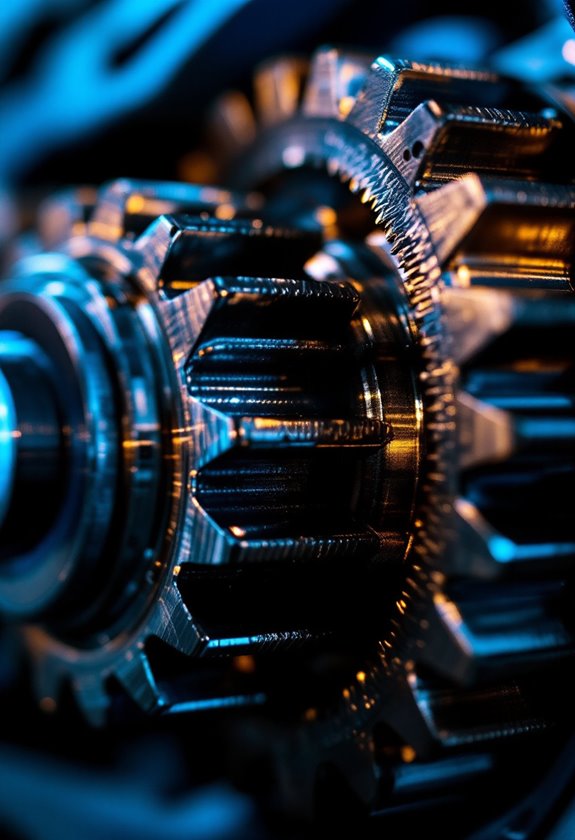
Exploring the components of pinion and spur gears reveals the intricate design that makes our RC cars so thrilling to drive. The pinion gear directly attaches to the motor shaft and drives the system with its smaller size and fewer teeth, usually ranging from 13T to 42T. We must guarantee its pinion materials, often hardened steel, match the motor shaft diameter for power transfer. On the other hand, the spur gear acts as the driven gear, typically larger and boasting significant teeth counts like 47T, 80T, or even 100T. This spur design directly influences gear ratios, working perfectly with various pinion setups to create exciting performance. With proper installation, these components work together for a seamless driving experience. Choosing the right gear sizes can significantly impact RC performance, enhancing agility and speed through careful selection.
Recommended Products

Compatible with Traxxas Slash 4x4 4WD/2WD/VXL Rally/Stampede 4x4 VXL /Traxxas 1/10 Summit 1/10 E-REVO/T-Maxx/Jato/Rustler 4X4 VXL/Summit.

【Feature】64T main gear and 17T 21T 26T 29T motor gears combo. 64T steel gears general for 1/10 trams, 17T, 21T for HSP 94111PRO 94111, 26T for HSP 94107 94170, 94123, 941031,29T for HSP 94123

Made from tough hardened steel for superior strength and wear resistance, ensuring long-lasting performance in high-performance RC vehicles.
Gear Pitch and Tooth Specifications

Understanding gear pitch and tooth specifications is essential for optimizing your RC car’s performance. Gear pitch determines the size of teeth on a gear, greatly affecting tooth spacing and overall dimensions. There are two main measurement systems: diametral pitch and module. The pitch measurement involves counting teeth while measuring the gear’s outer diameter.
It’s imperative to guarantee gear compatibility; mismatched pitches lead to noise and faster wear. Common pitches include 32, 48, and 64 in imperial measurements, while metric gears follow classifications like 0.6 MOD or 1.0 MOD. Smaller pitch numbers mean larger teeth, beneficial for durability, while larger pitch numbers provide finer adjustments, ideal for on-road performance. Choosing the right specifications can enhance your RC experience dramatically! Additionally, understanding the impact of gear ratios on performance can help you achieve the optimal setup for your RC vehicle.
Recommended Products

【Hardened Steel】Hardened Steel Solid Construction, Work with Steel Spur Gear (Warm noted: please DO NOT assemble these pinion gears to plastic or aluminum spur gears, otherwise it may destroy your spur gear)


【High quality aluminum 7075 & Work Smoothly】M0.6 pinion gear set is of high quality metal construction. Rust-proof treatment on the surface of gear for long-lasting performance. Good machining made less rough and less noise than other pinions that make them roll smoothly.
Effects on Speed and Performance
The effects of gear ratios on speed and performance are truly fascinating, and they can make or break your RC car experience. When we choose higher numerical ratios, like 3.5:1 or more, we get explosive acceleration, but we also face acceleration trade-offs that limit our maximum speed. Conversely, opting for lower ratios, such as 2:1 or less, sacrifices that initial punch for greater top speeds during long runs. It’s crucial to find an efficiency balance—too high of a ratio can lead to overheating motors and reduced run times, while lower ratios can enhance fuel efficiency. Understanding these dynamics guarantees we optimize performance based on our track type, keeping both speed and handling in check for the ultimate racing experience! Additionally, investing in quality shock absorbers can significantly enhance your vehicle’s handling and stability, which is vital for managing different gear ratios effectively.
Recommended Products

TT motor robot metal gear motor operating voltage: 3V-6V DC, Output: 110 RPM

TT motor robot metal gear motor operating voltage: 3V-6V DC, Output: 110 RPM

【Precise Compatibility & Versatile Application】Our 32P pinion gear set is engineered for 1/10 scale RC cars with 3.175mm shaft motors. It offers broad compatibility with popular brands including Traxxas, Arrma, Tamiya, and Losi. These pinion gear options provide flexible gearing solutions for various track conditions and driving styles.
Torque and Power Relationships

When we explore torque and power relationships in our RC cars, it quickly becomes clear how essential gear ratios are in optimizing performance. By understanding torque multiplication, we can harness the power of gear ratios effectively. For instance, a 10:1 ratio transforms a mere 0.05 ft-lbs of input torque into an impressive 0.50 ft-lbs output. However, we must also remember the inverse relationship between torque and speed; as one increases, the other decreases. Higher gear ratios might boost speed but reduce torque available to the wheels, while lower ratios enhance torque multiplication and provide better acceleration. Balancing torque and speed is key to maximizing our RC cars’ efficiency and performance during different driving situations. Additionally, size plays a significant role in selecting the right gear ratio for specific RC models, ensuring optimal performance in various scenarios.
Recommended Products

BROAD COMPATIBILITY FOR 1/10 SCALE MODELS: Designed specifically for 1/10 scale trucks, crawler, buggy, and monster RC cars, this gear set is compatible with a wide range of popular 5mm shaft motors, including both brushless and brushed types, such as 540/550 motors. It is an ideal upgrade or replacement part for Tamiya TT01, TT02, Traxxas, Axial, Arrma, HPI, Kyosho, and Losi.

FUNCTION OF THE 32P PINION GEAR: The hardened pinion gear sets are suitable for 1/10 RC car. Compatible with 0.8 metric pitch. 32P(32DP) is the pitch of each tooth on the pinion gear and the 20T 21T 22T 23T 24T is the number of teeth on the pinion gear

Our plastic Gears are suitable for science DIY model projects, such as the RC model electric robot and windmill, laboratories, science education such as displaying how gear ratios work, learning about gear mechanics and engineering principle, and any other family small motor DIY project.
Final Drive Ratio and Rollout Calculations
Final drive ratios (FDR) play an essential role in how our RC cars perform on the track, allowing us to customize acceleration and top speed. Understanding FDR helps us make efficient final drive adjustments for our specific racing needs. A higher FDR means our car quickly accelerates but may limit top speed. Conversely, a lower FDR boosts top speed but sacrifices acceleration. To calculate FDR, we can use the formula: final drive ratio = internal ratio × (spur teeth ÷ pinion teeth). By tweaking these ratios, we can optimize our cars for different track conditions, truly tapping into the ratio implications. With the right adjustments, we unleash our RC cars’ full potential, enhancing our racing experience! Additionally, motor timing optimization can further enhance acceleration and throttle response, complementing the effects of gear ratio adjustments.
Recommended Products

【Durable】Durable metal construction for long-lasting performance.

Optional Traxxas Pinion gears allow you to increase or decrease the final drive ratio and tune for different applications

Optional Traxxas pinion gears allow you to increase or decrease the final drive ratio and tune for different applications
How Do I Choose the Right Gear Ratio for My RC Car?
When we’re fine-tuning our RC cars, we’ll glide through a gear ratio calculator to find the perfect balance. By considering our performance goals, we guarantee our cars dance on tracks, whether sprinting or climbing.
Can Gear Ratios Affect Battery Life in My RC Car?
Yes, gear ratios definitely affect battery life in our RC cars. By optimizing performance with the right ratio, we can enhance battery efficiency, balancing speed with runtime for a superior driving experience.
What Tools Do I Need to Change Gear Ratios?
To change gear ratios, we need gear ratio tools like hex drivers, pliers, and a gear mesh gauge. Using proper adjustment techniques will guarantee peak performance and longevity for our RC cars. Let’s get started!
Do Gear Ratios Impact Tire Wear on My RC Car?
Yes, gear ratios do impact tire wear on our RC car. They influence tire degradation and help maintain performance balance, ensuring we optimize our setup for consistent lap times and prevent premature tire failure during races.
Is It Possible to Track Gear Ratio Changes During Races?
Yes, it’s possible to track gear ratio changes during races using race telemetry. By integrating gear monitoring systems, we can quickly assess how our adjustments affect performance in real-time, optimizing our strategy on the track.