As an Amazon Associate, we earn from qualifying purchases. Some links on this site are affiliate links at no extra cost to you. Our recommendations are based on thorough research and editorial judgment.

What Is an RC Car Center Differential? Operation and Oil Tuning

An RC car center differential sits between the front and rear drivetrains of a compatible 4WD vehicle. It allows their outputs to turn at different speeds. Silicone fluid in a sealed gear differential adds resistance to that speed difference, giving another handling adjustment. It is not an automatic system that sends all power to whichever axle has grip, and not every 4WD car has one.
Key Takeaways
- A center differential permits front-to-rear output speed differences; axle differentials separately handle left-to-right differences.
- A typical open gear differential does not actively select the axle with more grip.
- Fluid viscosity changes coupling and handling; the useful starting point depends on the exact differential and track.
- Inspect seals, gears, bearings and fluid condition according to the vehicle’s service instructions.
- A center differential, a slipper clutch and a solid center drive perform different jobs and are not universal substitutes.
Function and Purpose of Center Differential
Front and rear axles can need different average speeds during a turn or when tires unload. A center differential accommodates this difference. In an ideal symmetric open gear differential, output torques are approximately equal, but power is not fixed at 50/50: power also depends on rotational speed. If one axle offers little resistance, useful drive at the other can be limited. Tire contact still matters; suspension settings such as droop travel address a different part of that problem.
How the Center Differential Operates
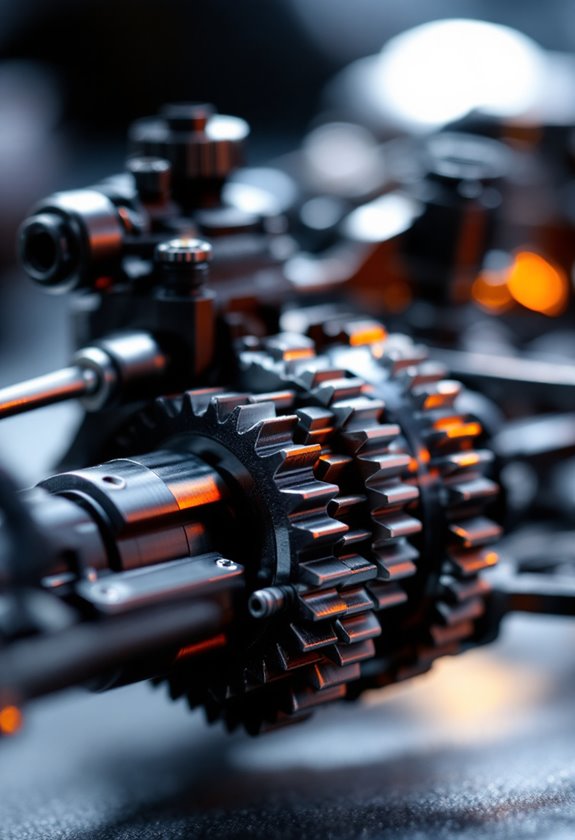
In a common sealed gear design, the housing drives internal gears connected to the front and rear outputs. Those gears allow relative rotation. Silicone fluid resists that motion: thicker fluid generally gives stronger coupling, while thinner fluid allows freer differential action. Internal layouts vary, so “planetary” is not a necessary description of every RC center differential. The shock-oil viscosity guide concerns suspension damping; its recommendations should not be transferred to differential filling or tuning.
Understanding Power Distribution in 4WD Vehicles
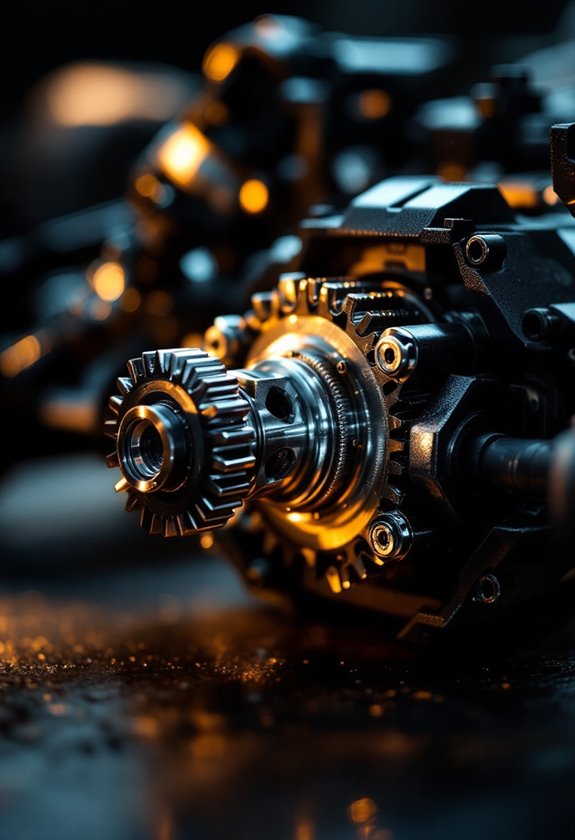
Consider acceleration with a lightly loaded front end. A freely acting center differential can let the front drivetrain spin much faster, rather than directing everything to the rear tires. More viscous fluid can resist that unloading, but it changes cornering too. Healthy driveshafts and correctly fitting CV joints transmit the resulting drive; replacing them does not itself create a traction-sensing differential.
Mechanical Benefits of Center Differentials
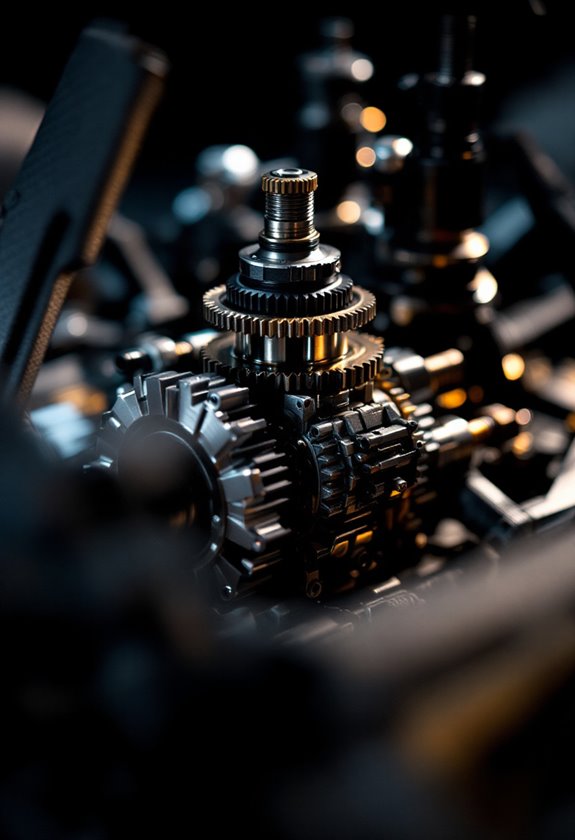
Allowing front-to-rear speed differences can reduce the constraint imposed by a solid center connection during cornering. This is not an overload guarantee or a cure for left-to-right wheelspin. A slipper clutch can limit transmitted load by slipping; a center differential primarily permits different output speeds. Evaluate the drivetrain’s actual behavior rather than assuming every tuning change improves performance.
Performance Improvements With Center Differentials
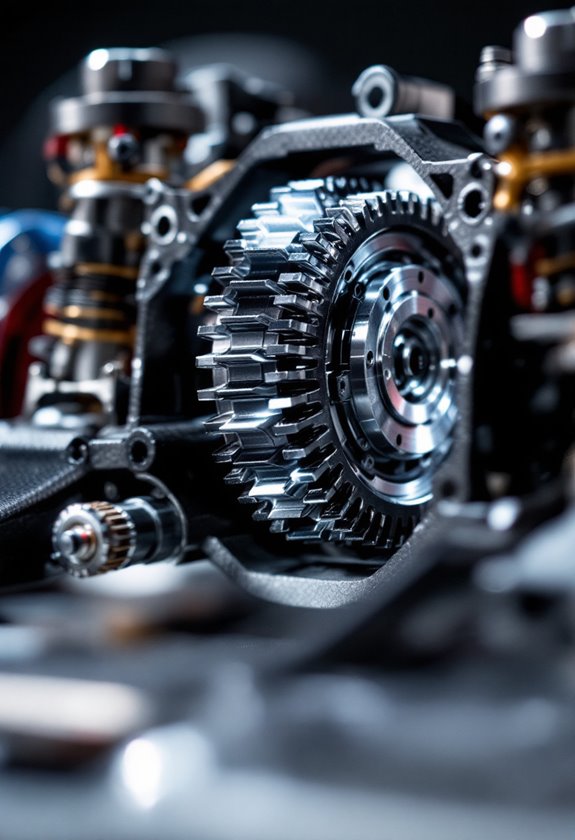
A useful tuning result is a car that exits corners predictably without excessive front unloading. Compare one change at a time on the same surface, with similar tires and battery condition. There is no universal viscosity that improves every vehicle. Keep motor settings constant while evaluating a differential change, so two different adjustments do not obscure the result.
Effects on Vehicle Handling and Stability
Center coupling changes how acceleration interacts with the front and rear drivetrains. It cannot guarantee stability or prevent a slide. Steering input, tire grip, suspension and throttle application still determine whether the car follows the intended line.
ARRMA’s TLR Tuned Typhon guidance describes thinner center fluid as allowing more front unloading and more off-power steering; thicker fluid increases coupling and on-power steering on that platform. These are setup tendencies, not a promise for every chassis. Record the starting setup and use the correct fasteners and service parts when reassembling the differential.
Customization Options for Tuning
Changing the motor pinion or spur changes the overall reduction between the motor and drivetrain. It does not, by itself, choose a new front-to-rear torque split. Keep gearing within the vehicle and motor/ESC limits, and distinguish a gearing change from a change to the differential’s internal coupling.
For a sealed gear differential, fluid choice is a separate adjustment. Start from a documented setup for that model, change one variable, and compare acceleration and cornering behavior. More resistance is not automatically better on rough or slippery tracks.
Oil Viscosity and Differential Behavior
Viscosity numbers must be interpreted in their actual application. For example, the XRAY XB4’26 manual lists center-differential suggestions of 50,000, 100,000 and 500,000 cSt for different traction conditions. Those are XB4 setup examples, not a range for all brushless cars. Very thick fluid can approximate a more constrained center drive while still differing from a mechanical lock. Follow the specified fluid type and filling procedure; overfilling can interfere with operation as the fluid heats and expands.
Applications for Center Differentials
Center differentials appear in various 4WD buggies, truggies and other performance platforms. They are useful where designers want adjustable front-to-rear coupling, but other cars use a slipper, a solid center drive or another arrangement. Vehicle class alone does not establish which conversion fits or whether a center differential suits a particular surface.
Comparison With Other Power Distribution Systems
“Center” describes where the differential acts; “open” describes how it operates. A center differential can therefore be an open gear differential. Adding viscous resistance changes its coupling, while a spool mechanically ties the front and rear outputs together. A slipper limits input load by frictional slip. Electronically controlled torque vectoring is another architecture and should not be attributed to an ordinary silicone-filled RC gear differential.
Center Differential in Traxxas 4×4 Models
On a Traxxas 4×4, first identify the exact vehicle, revision and installed center-drive assembly. A part described for one platform is not automatically compatible with every Traxxas 4×4. Verify the kit’s part number, required companion parts and specified fluid before ordering or installing it. The instructions for that kit take priority over a setup intended for a different vehicle.
Use that assembly’s service procedure for sealing, filling and reassembly. A change in front unloading or wheelie behavior can be a tuning observation, but it does not prove a particular fluid has degraded. Compare the same setup and inspect for leaks or wear before choosing a different viscosity.
Considerations for Different Vehicle Types
A conventional 2WD car has no driven front-to-rear split for a center differential to manage. A 4WD car may have three differentials, but it need not: some use a solid center drive or a slipper instead. Brushless power does not prescribe one viscosity range. Identify the drivetrain layout, starting setup and operating conditions before treating an aftermarket part as an upgrade.
Recommended Products

High-performance 6061-T6 aluminum upgrades include: caster blocks, steering blocks, rear hub carriers, steering bellcranks, differential housings, gear cover, motor moun…

High-performance 6061-T6 aluminum upgrades include: caster blocks, steering blocks, rear hub carriers, steering bellcranks, differential covers, transmission gear cover,…

Unleash 6S Brutal Power: Experience track-dominating speed with the factory-installed 4274-2050KV brushless motor and 180A waterproof ESC. Capable of hitting 80+ km/h, t…
As an Amazon Associate I earn from qualifying purchases.
Innovations in Differential Design
Differential assemblies can combine composite housings, metal outdrives, seals and gears of different materials. The XB4’26 center gear assembly, for example, includes composite components; aluminum is not a universal replacement for every part. Material names and CNC machining alone do not establish fit, service life or suitability for a different chassis.
If a locked center drive is required, use a purpose-designed option approved for the vehicle and understand the handling and load changes. Packing a differential with improvised material is not equivalent to a specified spool conversion. A rebuild or fluid change should preserve correct gear engagement, sealing and free movement rather than promise an automatic speed increase.
How Does a Center Differential Affect Battery Life in RC Cars?
A center differential does not guarantee longer runtime. Wheelspin, fluid resistance, gearing, tires and driving style all influence energy use. Compare runtime under similar conditions if it matters to your setup; do not infer battery savings from the presence of a differential alone.
Can I Install a Center Differential in Any RC Vehicle?
No. The chassis must accommodate the assembly, mounts, drive outputs and gearing, and some conversions require additional parts. Confirm the manufacturer’s application list for the exact model and revision rather than relying on vehicle scale or brand alone.
What Are the Signs of a Failing Center Differential?
New grinding, leaks, rough rotation or a marked change in drive behavior warrant inspection. These signs can also come from bearings, shafts or other gears, so they do not uniquely diagnose the center differential. Stop running a damaged drivetrain and inspect the relevant parts with power disconnected.
How Often Should I Change the Differential Oil?
Use the inspection and service schedule for the vehicle and its running conditions. Leakage, contamination, wear and a planned setup change can justify a rebuild. Running time, load and exposure are more useful considerations than assuming every center differential needs the same calendar-based oil change.
Is a Center Differential Necessary for Beginner RC Drivers?
Driver experience does not determine the drivetrain design. A beginner can use the center differential already fitted to a suitable ready-to-run car and leave its factory setup unchanged. There is no need to remove it or buy a conversion simply because the driver is new.