

What Is RC Car Ride Height?
RC car ride height is the measurement of the chassis height above the ground, fundamentally impacting vehicle handling and stability. Proper ride height adjustments can enhance grip and cornering precision, leading to improved racing performance. We can fine-tune front and rear heights for different track conditions, making our cars more adaptable. Understanding this key element helps us boost our overall performance on the track. Stick around to uncover more about optimizing your setup!
Key Takeaways
- Ride height measures the chassis height above the ground, affecting vehicle clearance and handling dynamics.
- Correct ride height enhances aerodynamic efficiency, reducing drag and improving vehicle stability during acceleration.
- Adjustments to front and rear ride height influence grip, cornering precision, and overall handling characteristics.
- Various methods exist for adjusting ride height, including threaded collars, pre-load clips, and shock mounting position changes.
- Accurate calibration and consistent testing optimize ride height for varying track conditions, improving traction and performance.
Definition of Ride Height in RC Cars
Ride height is an essential measurement in the world of RC cars, determining how far the chassis sits above the ground. It represents the distance from the bottom of the chassis to the track surface, impacting vehicle clearance and handling. Accurate ride height measurements at the front and rear are fundamental for tuning our cars. We need to measure with the vehicle in race-ready condition, guaranteeing all electronics and batteries are installed for accurate weight distribution. Utilizing measurement techniques like static and dynamic measurements helps us find the best setup. By adjusting pre-load clips and shock collars, we can fine-tune ride height, making our cars more responsive during races. Understanding ride height guarantees we’re on the right track! Hybrid designs with ceramic balls can also contribute to improved performance, reducing friction and enhancing speed in RC vehicles.
Importance of Ride Height in Racing Performance
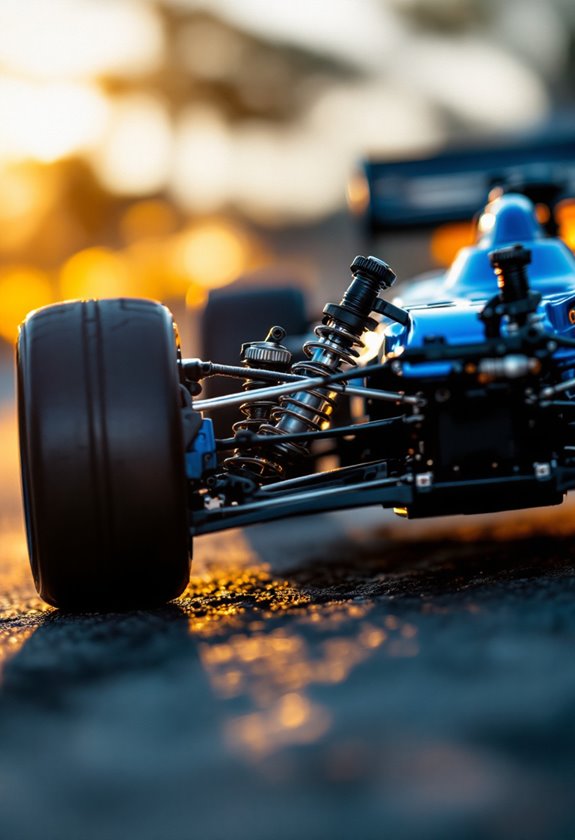
When we think about racing performance, the importance of ride height can’t be overstated. Choosing the right ride height is essential to our racing strategy. A lower ride height reduces aerodynamic drag, making our cars slice through the air more efficiently and increasing straight-line speed. It also stabilizes the vehicle, particularly during rapid acceleration, keeping us on track and predictable even at high speeds. Optimizing ride height allows us to adapt to various track conditions, such as bumps or loose surfaces, helping us maintain grip. By fine-tuning this setting, we can enhance our car’s handling and traction, ultimately maximizing performance and giving us that competitive edge. Additionally, using high-quality shock absorbers can further improve vehicle stability and responsiveness, enhancing our overall racing experience. So, let’s make ride height a top priority in our racing setup!
Front Ride Height Adjustments and Their Effects
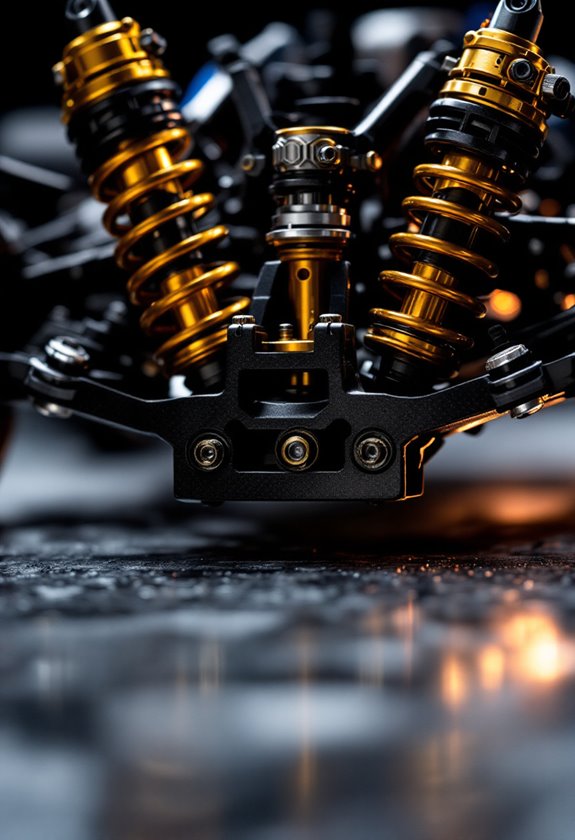
Adjusting the front ride height of your RC car can considerably impact its performance on the track. By making front axle adjustments, we can influence chassis dynamics and how our vehicle handles. A lower front ride height typically enhances steering response and grip during cornering, allowing for quicker turns and greater acceleration. The chassis remains flatter, which reduces body roll and results in more aggressive handling. On the other hand, raising the front ride height can make the car easier to control, with decreased sensitivity and more forgiving performance on rough surfaces. Adjustments can be made using spring collar threading or spacers, ensuring that we maintain accurate measurements and consistent settings for the best results. Additionally, understanding droop travel is crucial as it affects tire contact with the ground and overall vehicle stability. Let’s optimize and fine-tune!
Rear Ride Height Effects on Handling
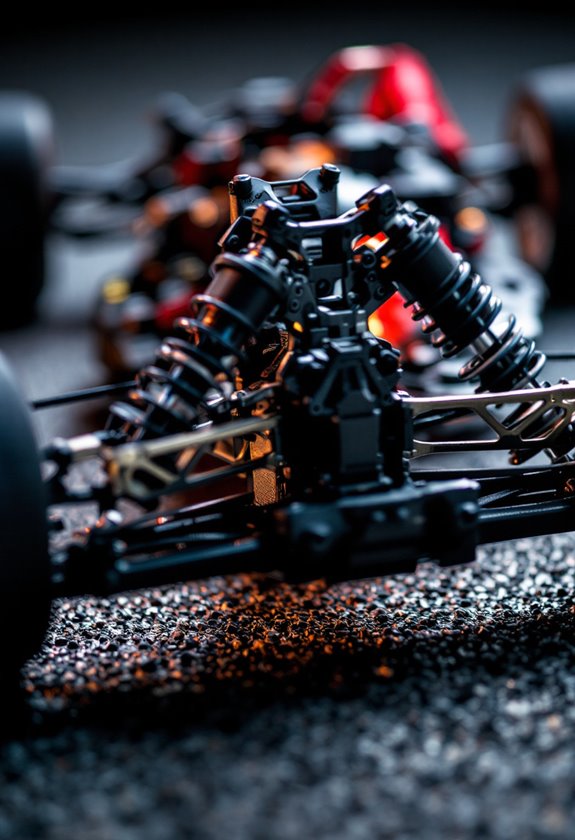
Understanding rear ride height is just as important as mastering front adjustments for your RC car’s performance. Adjusting the rear ride height greatly influences your car’s handling, especially regarding rear weight transfer and cornering precision. A lower rear ride height keeps the center of gravity close to the track, enhancing grip and enabling better corner entry control. In contrast, a higher rear position leads to increased weight transfer, causing the car to rotate more during turns, which can compromise stability. Even a small 1mm change can drastically alter handling characteristics. Ultimately, discovering the perfect rear height will boost your performance and make your driving experience more enjoyable on different terrains! Additionally, using a reliable ride height gauge can help ensure that your adjustments are precise and consistent.
Methods for Adjusting Ride Height

Adjusting your RC car’s ride height is essential for enhancing performance and achieving the best handling possible. There are several effective adjustment techniques we can use. First, the threaded collar method lets us twist collars up to increase ride height or down to lower it, giving us precise control. Second, we can install or remove pre-load clips for quick height adjustments, providing discrete increments without needing tools. Additionally, adjusting spring tension directly impacts both ride height and suspension stiffness, making our cars adaptable. Finally, changing shock mounting positions can adjust height while maintaining optimal shock travel. Each method has a significant influence on how ride height impacts our car’s performance, so let’s explore these options carefully! Additionally, having a comprehensive screw kit ensures that you have all the necessary parts for any adjustments you may need to make during your modifications.
Tools Needed for Ride Height Adjustment
When it comes to achieving the perfect ride height for your RC car, having the right tools at your disposal can make all the difference. You’ll want to start with ride height tools like gauges that can accurately measure your suspension height. We suggest the LMR Twister Ride Height Gauge for adjustable measurement ranges. Don’t forget droop blocks for proper positioning while adjusting suspension settings; they’re essential for balancing your car. Also, precision is key, so using calipers to measure from the wheel nut center to the shock mounting screw can guarantee consistent droop settings. And, for the tech-savvy, digital and Bluetooth-enabled setups offer real-time data for fine-tuning. With these tools, adjust ride height with confidence! Additionally, upgrading to high-density rubber tires can further enhance traction and improve overall vehicle performance.
Measurement and Setup Considerations
Achieving the perfect ride height is vital for optimizing your RC car’s performance, so let’s explore the key measurement and setup considerations you should keep in mind. First, our measurement techniques should focus on flat chassis areas, especially behind the front arms. It’s important to let the car settle naturally before taking distance readings. For on-road cars, a couple of taps help, while off-road vehicles need a drop from eight inches for accurate settling. We can utilize ride height gauges or even vernier calipers for precise measurements. Consistency is key, so let’s routinely check for dirt or obstructions that can affect our setup strategies and guarantee smooth performance in every race.
Performance Impacts of Ride Height Changes
Understanding the performance impacts of ride height changes is essential, especially since they can dramatically affect how your RC car handles on the track. A lower ride height generally increases tire contact, enhancing grip on smooth surfaces, while a higher height might help on bumpy tracks. When we raise the front, we increase drag, leading to slower speeds due to greater air resistance. Lowering the front improves steering response by shifting weight bias forward. However, we must balance these adjustments with suspension dynamics. It’s important to remember that changes in ride height affect overall vehicle stability too, which influences our cornering and throttle response. Through proper performance tuning, we can optimize our RC car’s ride height for its specific environment.
Fine-Tuning Ride Height for Optimal Performance
Fine-tuning your RC car’s ride height is essential for releasing its full performance potential on the track. To get started, we use ride height calibration tools like gauges to measure accurately at consistent chassis points. The ideal baseline for 1/8 scale buggies typically sits at 24mm front and 28mm rear.
Next, we make adjustments using spring collar techniques. Tightening collars raises the ride height, while loosening them lowers it. Remember, lower settings work better on flat, high-grip surfaces, while higher setups tackle bumps effectively.
As we test and log data, we’ll find that fine-tuning our setup improves handling and traction. Each adjustment helps us dial in our suspension tuning for peak performance on each unique track!
Frequently Asked Questions
How Does Ride Height Affect Battery Life in RC Cars?
Ride height affects battery life by influencing weight distribution, which can impact battery efficiency. By optimizing our setup, we can enhance how energy is used, potentially extending our run time on the track considerably.
Can Ride Height Impact Tire Wear Rates?
Yes, we can see how ride height impacts tire wear rates. As we adjust it, we tweak tire pressure and car handling, influencing how tires grip the track and wear down, just like tuning a musical instrument.
What Ride Height Is Best for Beginners?
For beginners, we recommend starting with 24 millimeters front and 28 millimeters rear ride height. These basic adjustments will guarantee easier handling, providing a solid foundation as we develop our racing skills together.
Do Different Surfaces Require Different Ride Heights?
Absolutely, different surface conditions demand varied ride heights! Terrains can change our car’s behavior, enhancing grip on smooth tracks while needing more clearance for bumpy paths. Choosing wisely guarantees peak performance no matter the challenge we face!
How Often Should I Check My RC Car’s Ride Height?
We should check our RC car’s ride height frequently, ideally before every race session or practice day. Regular inspection guarantees peak performance and helps us catch any needed adjustments quickly, enhancing our overall driving experience.