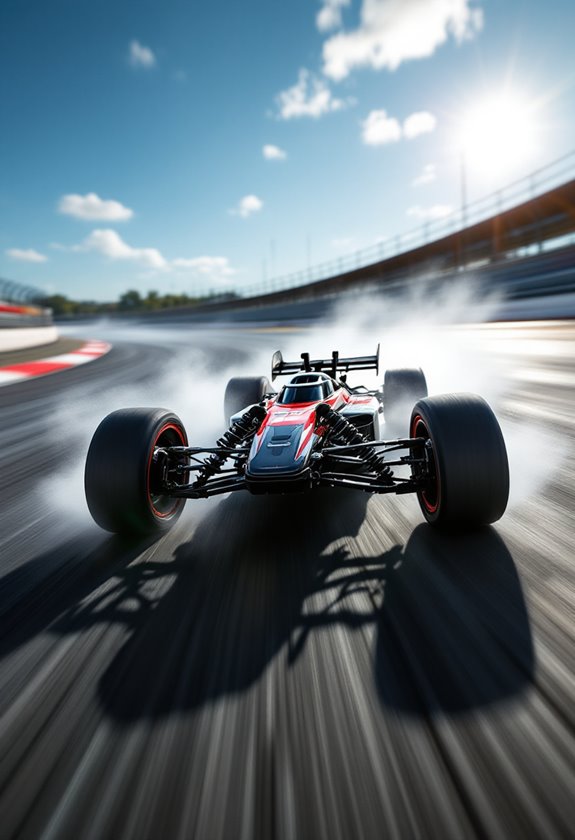


Setting up your RC car’s aerodynamics can greatly boost your performance on the track! First, we should focus on downforce; it improves tire grip for cornering. Next, adjust the rear wing and consider front features like splitters for better stability. We can minimize drag by streamlining the body shape and using tapered designs. Remember, tire choice also plays an essential role. Let’s optimize our setup for each unique track and see how exciting adjustments can elevate our racing game!
Key Takeaways
- Design a streamlined body using high-quality Lexan to minimize drag and enhance durability for better performance on the track.
- Adjust wing angles and front aerodynamic features to balance downforce and drag, optimizing cornering grip and stability.
- Maintain proper weight distribution for effective tire loading, improving steering response and reducing wheel spin during acceleration.
- Incorporate venturi tunnels, flat underbodies, and smooth surfaces to enhance airflow and reduce skin friction drag.
- Conduct coast-down testing to evaluate aerodynamic configurations, refining designs based on performance data for consistent improvements.
Understanding Aerodynamics in RC Cars
When we think about driving our RC cars, understanding aerodynamics can really give us an edge. Aerodynamic principles play a vital role in how our cars interact with the air as they race. By improving airflow management, we can minimize drag, which reduces air resistance and boosts our top speeds and acceleration. One effective way to achieve this is by choosing streamlined, low-profile body designs that slice through the air more efficiently. Additionally, we must balance drag reduction with the need for stability and performance on different tracks. High-quality Lexan bodies, known for their superior durability and impact resistance, can also contribute to maintaining aerodynamic efficiency. So, let’s pay attention to these aerodynamic elements and make smart adjustments, ensuring we’re maximizing our cars’ potential and cruising past our competitors with confidence and style.
Importance of Downforce for Grip
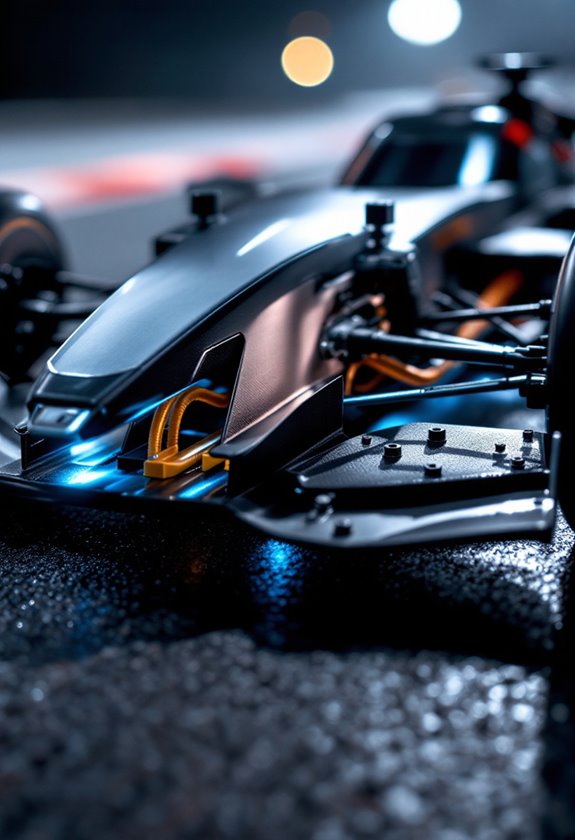
Understanding the importance of downforce for grip is essential if we want to optimize our RC car’s performance on the track. The primary downforce benefits come from increased tire load, which enhances grip enhancement considerably. This added grip allows us to corner faster and brake more reliably, reducing tire slip. What’s really exciting is that this extra force scales with our speed—higher speeds mean even more downforce! Not only does this lead to improved lap times, but it also helps our tires wear more evenly by minimizing sliding and slip. Effective downforce management balances all four tires, ultimately improving our car’s stability and handling. With the right setup, we can transform our racing experience, making those laps feel seamless. Additionally, understanding tire compounds can help us select the best tires for maximizing downforce and grip.
Rear Wing Design and Adjustment
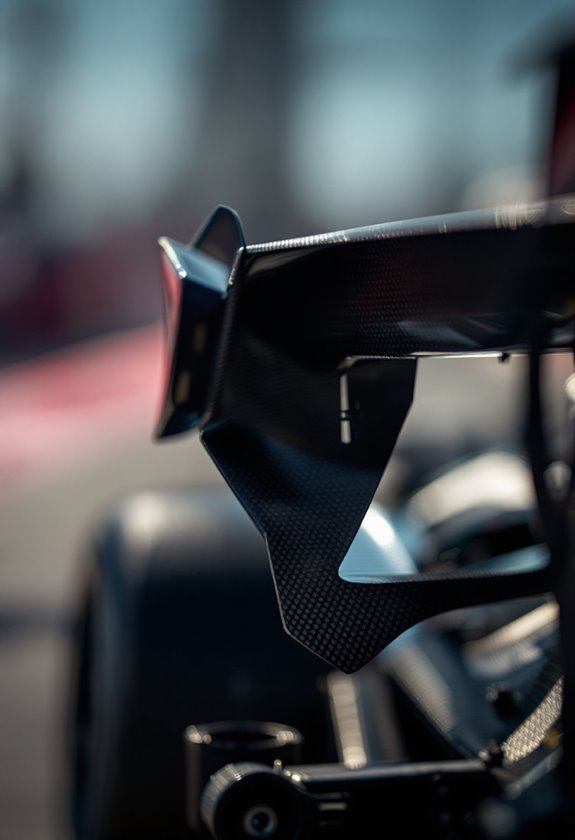
The rear wing design and adjustment play an essential role in how our RC car controls and performs on the track. We must consider various aerofoil profiles, such as inverted airfoils optimized for downforce. Multi-element wings can enhance efficiency while minimizing drag. Adjusting the wing angle is critical; a higher angle increases downforce but may lead to extra drag, reducing our top speed.
Finding the right balance is fundamental for our unique driving style and track conditions. Proper mounting is equally important since positioning affects airflow and downforce effectiveness. By paying attention to these factors, we can maximize stability and handling, allowing our RC car to achieve faster lap times with confidence in every corner. Additionally, selecting the right material quality for your spoiler can greatly impact both durability and aerodynamics.
Front Aerodynamic Features

Front aerodynamic features are vital for maximizing the performance of our RC cars on the track. A well-designed front wing can create substantial downforce, especially when combined with effective splitter design, which directs high-pressure air above the car. Dive planes add even more front grip by channeling airflow and stabilizing the car during cornering. Hood vents are important for releasing hot air from the engine, maintaining peak performance while reducing under-hood pressure. With active aerodynamics, we can adjust components like the front wing or flaps in real-time to enhance our car’s handling. By tuning these features for pressure management, we guarantee our RC cars grip tightly to the track, giving us that much-desired edge in performance! Additionally, the use of quality shock absorbers can further improve handling stability, making it easier to take advantage of aerodynamic enhancements.
Minimizing Drag for Increased Speed

Minimizing drag is essential for boosting the speed of our RC cars, and there are plenty of effective strategies we can use. First, let’s streamline our car’s body shape. By reducing bluff areas, we lower pressure drag and enhance airflow management. Consider designing a tapered rear end, as this can decrease drag by up to 30%. We can also incorporate features like venturi tunnels or flat underbodies, which help control airflow beneath our cars. Additionally, using smooth surfaces and low-friction coatings reduces skin friction drag. Finally, if we’re feeling adventurous, consider adding active drag reduction systems, like adjustable flaps, for real-time optimization. These steps will have our RC cars speeding ahead while keeping drag at bay! Moreover, utilizing advanced charging features can ensure that we spend more time racing and less time waiting for our batteries to recharge.
Balancing Front and Rear Downforce
While we’re racing our RC cars around the track, achieving a perfect balance between front and rear downforce is vital for peak performance. Proper aerodynamic tuning helps us fine-tune our cars, allowing for better cornering stability and handling. If we apply too much front downforce, we risk oversteer at high speeds, making it easier to spin out. Conversely, excess rear downforce can lead to understeer, reducing our maneuverability. To achieve balanced downforce, we need to make careful balance adjustments with our front splitters, lip spoilers, and rear wings. Each element influences how our car feels while traversing the track, so finding that sweet spot is essential for maximizing speed without sacrificing control. Additionally, considering suspension tuning regularity can further enhance overall vehicle performance and handling characteristics on the track.
Impact of Weight Distribution on Aerodynamics
When we think about aerodynamics in our RC cars, weight distribution plays a significant role in how our vehicles perform on the track. Proper weight positioning is essential to optimize tire loading, impacting traction and grip. If we put too much weight on the rear, we might experience wheel spin during acceleration. Conversely, shifting weight forward helps improve our steering response but can lead to instability in fast corners. A balanced setup helps maintain consistent tire contact, enhancing aerodynamic efficiency. During turns, if the weight shifts unevenly, it can result in understeer or oversteer, affecting control. By adjusting our battery and components, we can achieve the perfect weight distribution to elevate our racing experience while enhancing stability and cornering performance.
The Role of Body Shape and Design
The shape and design of our RC car bodies play an essential role in how they perform on the track, greatly impacting both speed and handling. Optimizing body proportions is critical; smooth, streamlined shapes reduce drag and enhance airflow, boosting our top speed. We should consider longer noses or tapered fronts for better aerodynamic balance, ensuring we have enough front downforce for stability. Contour optimization is also essential—integrating elements like splitters and diffusers can generate extra downforce, improving grip. We must carefully balance drag with downforce; too much of one can hinder our performance. By paying close attention to these elements, we can enhance our RC car’s overall aerodynamics, leading to improved lap times and more enjoyable racing experiences.
Analyzing Suspension Effects on Aerodynamic Performance
Understanding how our suspension setup interacts with aerodynamic performance is essential for making our RC cars faster and more stable on the track. Suspension principles play a key role here, as they directly affect how our cars respond to aerodynamic forces. For instance, if we have a stiff suspension, it limits body roll, promoting consistent airflow and enhancing downforce generation. On the other hand, a softer setup may lead to aerodynamic instability, causing unpredictable changes in airflow. To maximize aerodynamic stability, we should consider how downforce impacts load distribution on our tires and choose springs and dampers that cope with these forces. Balancing these elements will fine-tune our car’s handling, resulting in enjoyable, responsive driving experiences.
Adjusting Airflow With Body Trim and Accessories
Getting the most out of our RC car’s aerodynamics starts with how we trim and accessorize the body. Body cutting is essential; we should carefully trim along the lower lines using a sharp hobby knife or Lexan scissors. Rounding the corners around wheel cutouts helps with airflow shaping, minimizing disruptions as we speed along the track. Maintaining a few millimeters of ground clearance lets air flow smoothly under our car. When adding a rear wing, steady mounting guarantees downforce and stability. Choose thicker, stable wings for high-speed runs, and adjust the angle based on our racing goals. Remember, proper body placement affects grip balance and airflow, so check fitment carefully to optimize performance!
Testing Aerodynamic Configurations
Testing various aerodynamic configurations is key to releasing our RC car’s full potential on the track. We can explore different setups through practical methods like coast-down testing and data logging. These techniques help us assess drag coefficients without wind tunnels, allowing for real-world evaluations. By tracking our speed, voltage, and RPM, we capture essential performance data that reveals the effectiveness of our modifications. Consistency is vital; maintaining stable conditions minimizes testing variability, ensuring accurate comparisons. As we refine our designs—whether through changing wing angles or altering body shapes—we’ll collect data that directly informs our next steps, driving us closer to peak performance. With patience and experimentation, we’ll find what works best for our racing needs!
The Influence of Tire Choices on Aerodynamics
When we plunge into the world of RC car racing, tire choices play an essential role in our vehicle’s aerodynamics. Tire deformation can dramatically alter our contact patch size, affecting airflow around the tire assembly. As we consider heat tolerance, slick tires often offer better grip consistency, enhancing aerodynamic stability. It’s fascinating how tire profiling affects performance, with wider tires increasing drag and altering airflow, while narrower ones reduce drag but may compromise grip. Understanding how these variables impact our setup is key to optimizing performance. We must pay close attention to each tire’s characteristics, ensuring we find the perfect balance of grip and aerodynamic efficiency for every race condition. This can make all the difference in our lap times!
Utilizing Aerodynamic Modeling Tools
Utilizing aerodynamic modeling tools can revolutionize how we set up our RC cars. With CFD software, we can conduct detailed aerodynamic simulations to analyze complex 3D shapes of our vehicle surfaces. This means we can design and test aerodynamic devices like spoilers and flaps, optimizing airflow to lower the drag coefficient. Advanced tools enable us to assess how different configurations impact our car’s speed and stability. Plus, many CFD platforms allow us to run these simulations right on our standard desktop computers, making it accessible. By validating these simulations with real data from our RC car tests, we can fine-tune our designs, ensuring maximum performance on the track. Let’s elevate our racing experience together!
Common Mistakes in Aerodynamic Setup
While aerodynamic modeling tools give us great insights into our RC car’s performance, putting that knowledge into practice can be tricky. One common mistake we can make is misunderstanding underbody airflow. Excessive holes or poor underbody design can create unwanted air vortices, destabilizing our speed. Also, not maintaining a smooth undertray reduces downforce. Another issue arises with control surface usage; overly aggressive deflections can disturb smooth airflow, leading to unexpected spins. We should also never overlook mechanical checks; loose parts can dramatically affect aerodynamics during races. Furthermore, using unsuitable body materials or neglecting terrain adjustments limits performance. By steering clear of these mistakes, we can harness the full potential of our RC car’s aerodynamics for an exhilarating driving experience.
Fine-Tuning for Specific Track Conditions
Fine-tuning our RC car for specific track conditions is vital for maximizing performance and getting the most out of our setup. We need to closely consider the track surface. For softer or loose surfaces, increasing downforce helps enhance tire grip and stability. However, on hard, smooth tracks, we should reduce downforce to cut drag and boost straight-line speed.
Environmental adjustments also play a huge role. Wind direction can shift our rear wing angle, while temperature changes might require tweaks to maintain ideal performance. Regularly testing our setup through simulation or on-track practice is important for refining our aerodynamic components. By effectively balancing our aerodynamic setup with mechanical settings, we make sure we’re ready to tackle any track challenge that comes our way!
Frequently Asked Questions
How Does Weather Affect Aerodynamic Performance in RC Cars?
Did you know that a 10-degree drop in temperature can boost aerodynamic downforce by 5%? Weather greatly affects our RC cars’ performance, with temperature effects and wind resistance altering grip and handling during races.
What Materials Enhance Aerodynamic Efficiency for RC Car Bodies?
Lightweight composites and thorough airflow simulations are essential for enhancing aerodynamic efficiency in our RC car bodies. By selecting advanced materials, we can optimize performance, reducing drag and improving stability on the track.
Can Wing Angles Be Adjusted During a Race?
In the fast-paced world of racing, wing adjustments aren’t typically feasible during a race. We carefully consider our race strategy beforehand, aiming for that perfect balance between grip and speed, optimizing our performance for each track.
How Do Tire Pressures Influence Aerodynamic Grip?
Tire pressure greatly influences grip dynamics, affecting the contact patch’s size and shape. By adjusting tire pressure, we can optimize grip, enhancing stability and cornering performance while ensuring our car effectively handles aerodynamic forces on the track.
What Tools Are Best for Measuring Aerodynamic Forces?
Sure, we could use a wind tunnel or computational fluid dynamics, but let’s just pretend our fancy car’s cruising through the air like a superhero! Seriously, those tools are what we’d recommend for measuring aerodynamic forces.