As an Amazon Associate, we earn from qualifying purchases. Some links may be affiliate links at no extra cost to you. Although our opinions are based on curated research, we haven't used these products. Articles generated with AI.


What Is RC Car Center Diff?

The center differential in RC cars is essential for balancing power between the front and rear axles. It lets each axle rotate at different speeds, especially during turns, improving handling and control. By adjusting torque distribution, it enhances traction on various surfaces, allowing us to tackle challenging terrains with ease. Using the right differential oil viscosity is key for ideal performance. Stick with us to uncover more details about this game-changing component!
Key Takeaways
- The center differential in RC cars controls power distribution between front and rear axles for improved handling and traction.
- It allows front and rear wheels to rotate at different speeds, enhancing performance during cornering and aggressive maneuvers.
- Utilizing different fluid viscosities in the center differential can optimize grip and stability on various surfaces.
- Regular maintenance, including checking fluid viscosity, is crucial for optimal center differential performance in RC cars.
- A center diff helps prevent drivetrain binding and ensures smoother operation across challenging terrains.
Function and Purpose of Center Differential
You may be interested



When we think about the function and purpose of a center differential in RC cars, it’s important to realize how vital it is for best performance. The center differential plays a vital role in power distribution between the front and rear axles. It allows them to operate independently, ensuring smooth handling and control under various driving conditions. For example, if the rear wheels lose traction, the center differential shifts power to the front wheels, helping us regain control. Under normal circumstances, it maintains a balanced 50/50 power distribution. This dynamic adjustment enhances traction control, reduces wear on components, and improves vehicle handling, allowing all of us to navigate challenging terrains with precision. A well-functioning center differential truly elevates our RC driving experience! Additionally, understanding droop travel is essential as it directly impacts how effectively the vehicle maintains tire contact with the ground.
How the Center Differential Operates
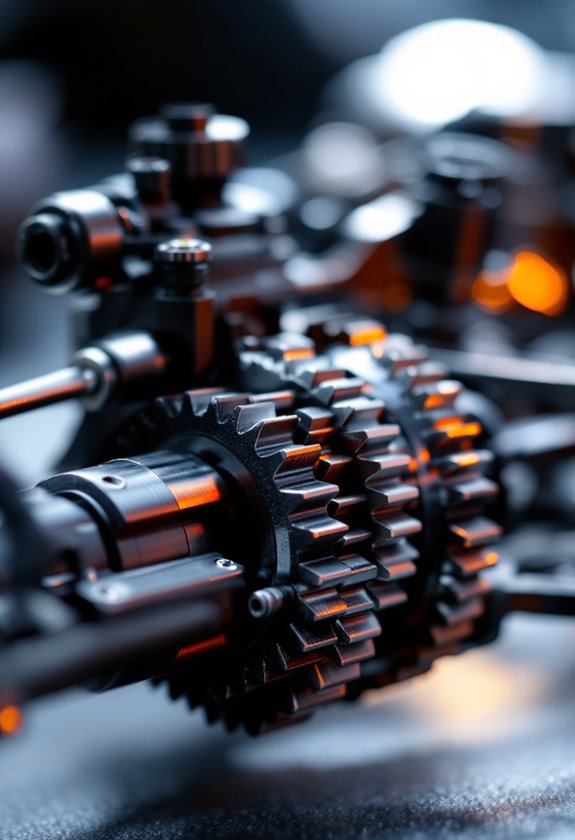
Understanding how the center differential operates is essential for getting the most out of your RC car’s performance. The center differential utilizes differential mechanics to allow front and rear axles to rotate at different speeds during cornering and varying traction dynamics. It features a mechanical system that adjusts rotational speed differences automatically, enabling smooth turns without tire scrubbing. Inside, differential gears work through a planetary gear arrangement that distributes torque while adapting to resistance differences. Fluid viscosity plays a key role here; thicker fluid creates more resistance, while thinner fluid promotes easier axle rotation. This means we can tune our RC car’s handling characteristics, enhancing grip and control, particularly during acceleration and sharp maneuvers. Using the right viscosity options ensures optimized performance in different driving conditions.
Understanding Power Distribution in 4WD Vehicles

Power distribution plays an essential role in the performance of 4WD vehicles, especially when we think about how the center differential functions. By understanding power dynamics, we can see how the center diff enhances traction management. When one set of wheels loses grip, the center differential cleverly shifts power—redirecting it to the wheels with more traction. This adaptability is crucial for maintaining control and stability during aggressive maneuvers. If we consider the viscosity of differential oil, it also directly influences power distribution; heavier oils can dampen performance. Ultimately, optimizing power distribution allows us to tackle challenging terrains and achieve impressive acceleration while ensuring all four wheels work in harmony. This fine balance is what makes our rides thrilling and reliable. Additionally, upgrading CV joints can further enhance power transmission and stability, ensuring your vehicle performs at its best in various conditions.
Mechanical Benefits of Center Differentials
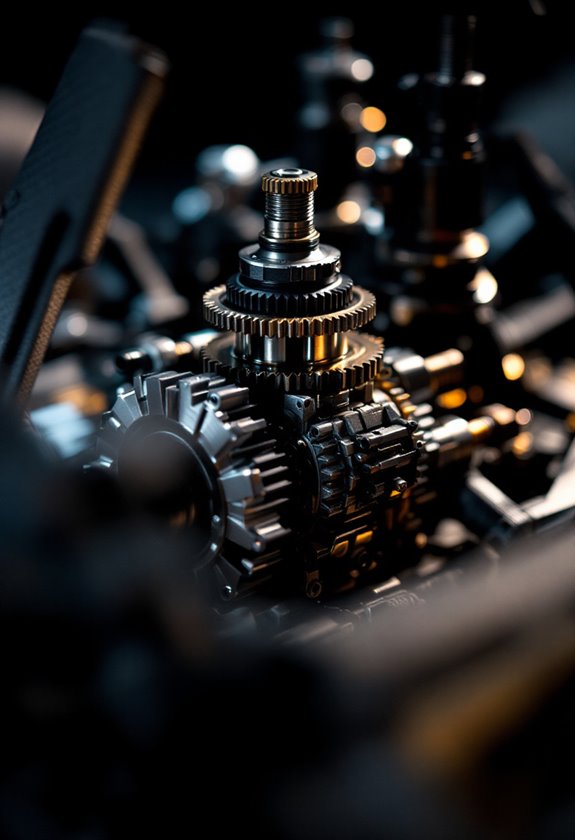
Center differentials not only enhance performance but also provide critical mechanical benefits for our vehicles. One major advantage is their ability to distribute mechanical stress effectively between the front and rear axles. This proper distribution reduces drivetrain binding, preventing damage during uneven terrain changes. Additionally, center differentials protect our axles from overload conditions, especially during intense traction scenarios. By allowing each axle to rotate at different speeds, we avoid single wheel spin situations, which can lead to excessive wear and tear. This way, we guarantee smoother operation and longer-lasting components. The dynamic power adjustments also contribute to ideal tire performance, reducing scrubbing and enhancing overall vehicle safety. With these benefits, center differentials are essential for peak mechanical efficiency in our RC cars. Furthermore, integrating real-time monitoring systems can provide insights into performance metrics that help optimize differential settings for various racing conditions.
Performance Improvements With Center Differentials
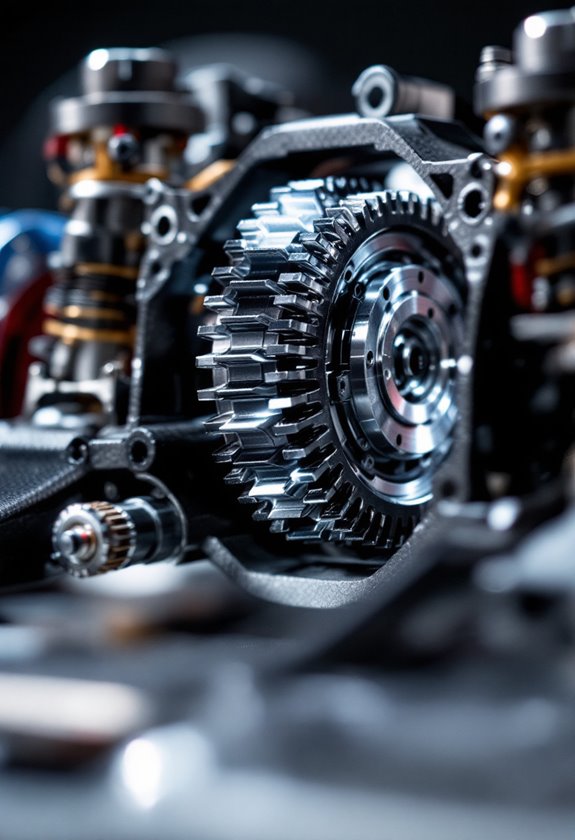
When we engage in performance improvements with center differentials, it’s clear that these components play an essential role in how our RC cars handle various driving conditions. By optimizing power distribution, center diffs enhance acceleration and traction control. Using thicker oils, like 15,000 to 30,000 cSt, allows for direct power transfer, giving us stronger acceleration out of corners and better grip on varying track surfaces. Differential tuning helps us manage traction effectively, so we get controlled tire spinning when the grip is low. Whether we’re racing on high-speed tracks or tight courses, adjusting fluid viscosity truly delivers performance enhancements that make a prominent difference. Additionally, motor timing optimization can further improve the overall responsiveness of our RC vehicles. Overall, a well-tuned center differential can elevate our RC driving experience remarkably!
Effects on Vehicle Handling and Stability
Vehicle handling and stability are greatly influenced by the effectiveness of our differential setup. A well-tuned center diff guarantees dynamic power distribution between front and rear axles, adapting to traction changes on varied terrain. This adaptability provides enhanced stability by redirecting power to the wheels with the best grip, preventing loss of control.
For improved handling, we must consider fluid viscosity. Choosing lighter fluid can boost off-power steering response, while thicker fluid enhances on-power steering precision. Finding the right balance is essential, as it impacts cornering performance and overall vehicle dynamics. When we optimize our center diff, we gain confidence in high-speed maneuvers and cornering, allowing us to enjoy the thrill of our RC cars while maintaining control and stability. Additionally, having a comprehensive screw kit ensures that we can easily make necessary adjustments and repairs to maintain optimal performance.
Customization Options for Tuning
Tuning our RC cars opens up a world of customization options that can truly enhance performance. One effective way to boost performance is through gear ratio adjustments. By swapping out different pinions and spurs, like a 46T center gear with a 17T pinion, we can fine-tune torque distribution between the front and rear axles. Perfect for specific performance needs, these modifications pave the way for better handling.
Additionally, lubrication modifications can greatly impact how our diffs work. Using high-viscosity oils allows us to modify differential actions effectively, ensuring peak performance in heavy-duty applications. Each tweak we make can elevate our vehicles, turning them into powerful racing machines ready to tackle any track we throw them on!

Precision RC hobby parts

Installs in gearbox to allow forward only operation

【Durable】Durable metal construction for long-lasting performance.
Oil Viscosity and Differential Behavior
Oil viscosity plays an essential role in how our RC car differentials perform on the track. When we choose a viscosity selection, we’re influencing our car’s power transfer and traction control. Low-viscosity oils, like 3,000 cSt, allow better differential action and steering response but can cause traction issues on slippery surfaces. Conversely, high-viscosity oils, such as 50,000 cSt, provide a more locked behavior, ensuring wheels spin at similar speeds but might hinder sharp cornering. It’s important to understand fluid properties, as using the wrong viscosity can lead to overheating or gear damage. By experimenting with different viscosities, we can optimize our cars for specific track conditions, enhancing our overall racing experience.
Applications for Center Differentials
When we’re out on the track or tackling tough terrain, having an effective center differential can make all the difference in how our RC cars perform. The right center diff optimizes power distribution for various surfaces, enhancing our off-road applications by improving traction on loose dirt, gravel, and even smooth pavement. We can accelerate more efficiently when power goes to the wheels with the most grip, ensuring better control during sharp turns and aggressive maneuvers. These racing advantages also extend to model-specific integrations, like Traxxas 4×4 platforms, helping us maintain stability and performance in any condition. With improved handling and component protection, we’re set up for success, whether we’re cruising around a race track or climbing rugged terrain.
Comparison With Other Power Distribution Systems
Understanding how center differentials compare to other power distribution systems helps us appreciate their unique advantages. Center diff advantages lie in their ability to dynamically shift power between the front and rear axles, unlike open differentials that deliver power evenly regardless of traction. This means when one axle slips, the center diff can redirect power to the axle with better grip, ensuring better stability and control—especially during high-speed maneuvers. In torque vectoring comparisons, while torque vectoring systems control wheel speeds individually for superior cornering, center diffs offer simpler mechanics with fewer failure points. Ultimately, center differentials provide a balanced mix of advanced traction management without the complexity of electronic systems, making them an appealing choice for RC enthusiasts.

【Weight Upgrade】This differential cover is upgraded and heavier, made of high quality brass, which is strong and wear-resistant.

CNC machined, replace original plastic parts and easy to install

1 million weight differential oil
Center Differential in Traxxas 4×4 Models
The center differential in Traxxas 4×4 models is a game-changer for RC enthusiasts looking to enhance their vehicle’s performance. This component dynamically distributes power between the front and rear wheels, offering superior control during turns. When installing it, make certain to use the thicker viscosity differential oil provided; this guarantees the correct operation and helps manage the vehicle’s power more effectively.
For maintenance practices, regularly check the fluid viscosity and replace it as needed. Adjusting the oil’s thickness can fine-tune the anti-wheelie effect as well. When set up properly, the center differential transforms your driving experience, improving handling and stability, especially in challenging terrain. So, let’s get our vehicles performing their best!

Differential oil kit contains 1 each: 10,000, 30,000, 50,000

Differential oil

Differential oil, 30, 000 weight
Considerations for Different Vehicle Types
Choosing the right differential setup is essential for maximizing your RC vehicle’s performance, especially since different types of vehicles have unique demands. For 2WD vehicles, we must focus on tuning strategies and careful oil selection, as a single rear differential handles all acceleration. In 4WD systems, we’ve got center diff types that manage power distribution, requiring coordinated adjustments to three differentials for peak performance settings. For high-performance brushless systems, thicker oils between 15,000-30,000 cSt are necessary to handle increased torque. We also need to take into account temperature impacts, as oil viscosity changes over time. By understanding vehicle compatibility, maintenance practices, and gear ratios, we can develop effective upgrade options that fit our specific racing applications and environments.
Innovations in Differential Design
Innovations in differential design are changing the game for RC enthusiasts, giving us more ways to enhance performance. One of the most significant design advancements is the use of Aluminum 7075-T6. This material replaces stock plastic components, offering incredible rigidity and wear resistance. Additionally, CNC precision manufacturing guarantees a perfect fit, improving differential efficiency.
Another exciting development is the implementation of silicone earplugs for easy center differential locking. This feature allows us to control power distribution, especially beneficial during stunts. We also see gear designs that minimize friction and boost durability, making our RC cars run smoother and faster. Finally, specialized fluids fine-tune power transmission, allowing us to customize handling for different surfaces. These innovations truly elevate our driving experience!
Frequently Asked Questions
How Does a Center Differential Affect Battery Life in RC Cars?
A center differential enhances battery efficiency by optimizing differential performance. It reduces motor strain and guarantees power distribution is balanced, preventing excessive energy waste. This means longer run times and less battery drain during our races.
Can I Install a Center Differential in Any RC Vehicle?
Sure, we can just slap a center differential onto any RC vehicle, right? Wrong! Installation compatibility’s key; not all vehicles support it. Incompatible setups can ruin performance, so we need to choose wisely.
What Are the Signs of a Failing Center Differential?
We’ll notice signs of a failing center differential, like grinding noises and overheating. To avoid issues, we should follow differential maintenance tips and troubleshoot center differentials regularly, ensuring peak performance and longevity.
How Often Should I Change the Differential Oil?
We should change our differential oil every month for high-power setups, or weekly for competitive racing! Don’t let oil viscosity fool us; consistent differential maintenance keeps our rides performing like they just rolled off the track!
Is a Center Differential Necessary for Beginner RC Drivers?
No, a center differential isn’t necessary for beginner RC drivers. We should focus on mastering basic driving techniques first, building our knowledge before tackling advanced features like differentials, which can complicate our early experiences.