As an Amazon Associate, we earn from qualifying purchases. Some links on this site are affiliate links at no extra cost to you. Our recommendations are based on thorough research and editorial judgment.

What Is RC Car Toe Setting?

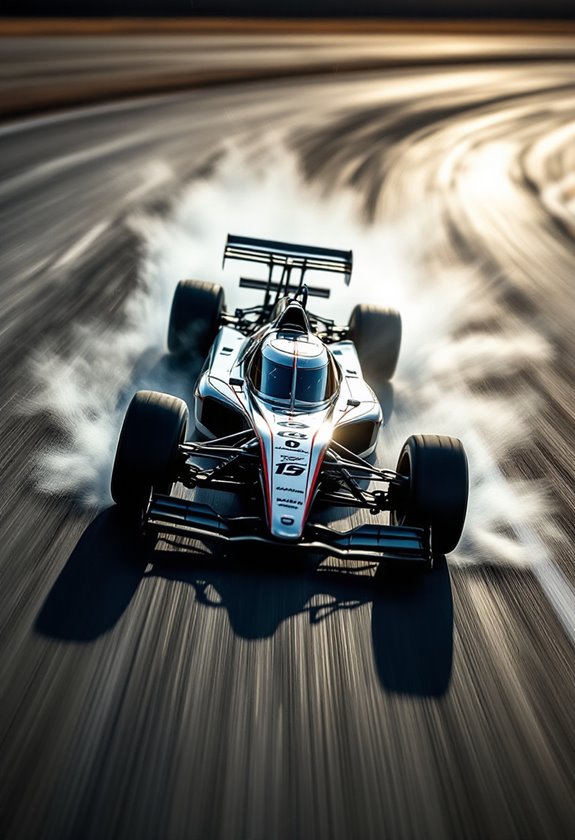
RC car toe setting refers to the angle of the wheels compared to the vehicle’s centerline. When we tweak the toe, we adjust how the wheels point—either inward (toe-in) or outward (toe-out). This adjustment can enhance traction and stability or improve quick turn response. For instance, a slight toe-in (1-2 degrees) at the front can considerably boost on-power handling. Let’s explore how to optimize your RC car’s performance through precise toe settings!
Key Takeaways
- Toe setting refers to the angle of the wheels relative to the vehicle’s centerline, influencing stability and handling.
- Positive toe (toe-in) enhances steering response and stability during acceleration, while negative toe (toe-out) improves initial turn-in but may reduce straight-line stability.
- It’s crucial to maintain proper toe settings for maximizing tire contact and overall driving experience in RC vehicles.
- Adjustments can be made through turnbuckle links for the front and adjustable components for the rear wheels, ensuring precise alignment.
- Recommended toe settings include 1-2 degrees of toe-in for front wheels and 2-3.5 degrees of rear toe-in for improved traction during acceleration.
Understanding Toe in RC Vehicles
You may be interested


When we talk about toe in RC vehicles, we’re diving into an essential aspect of tuning that can dramatically impact how our cars perform on the track. Toe refers to the angle of the wheels compared to the vehicle’s centerline. Positive toe angles create toe-in, pulling the wheels toward the chassis, while negative angles mean toe-out, pushing them outward. These toe angle theories influence vehicle dynamics, affecting both handling and stability. For example, a bit of toe-in can improve straightaway stability, while a touch of toe-out enhances turn-in responsiveness. To get the best performance, we need to carefully measure and adjust these angles. Remember, just a small tweak can lead to big changes on track day! Using the right RC toe gauges is crucial for achieving accurate adjustments.
Types of Toe Angles

Understanding the different types of toe angles is essential for getting the most out of your RC car’s performance. There are three main toe angle variations: toe-in, toe-out, and zero toe. With toe-in, the front wheels angle inward, boosting on-power steering response and traction. This setup shines in low-grip conditions. Toe-out angles, on the other hand, angle the rear wheels outward, enhancing the initial turn-in response but should be avoided in rear-wheel applications. Finally, a zero toe setting keeps wheels straight ahead, balancing stability and responsiveness. By mastering these toe angle effects, we can optimize our RC cars for specific tracks and driving styles, ensuring we have the best racing experience possible! Additionally, understanding high-current capacities can further enhance your vehicle’s performance by ensuring better acceleration and control.
Importance of Toe Settings
Getting the right toe settings for our RC car is essential to releasing its full potential on the track. Proper adjustments influence straight-line stability and cornering performance, providing us with a smoother, more controlled driving experience. Empirical studies show that a toe-in configuration can enhance stability during straightaways, while toe-out offers better responsiveness and agility during turns. These dynamics not only impact our car’s handling but also tap into psychological factors, boosting our confidence while driving. By fine-tuning our settings, we maximize traction and grip, ensuring we maintain an ideal tire contact patch. Additionally, understanding tire compounds is crucial as it allows us to select the right tires that complement our toe settings for optimal performance. Ultimately, the importance of toe settings goes beyond technical precision; it transforms the way we engage with our RC cars and enhances our overall racing enjoyment.
Front Toe Adjustment Methods
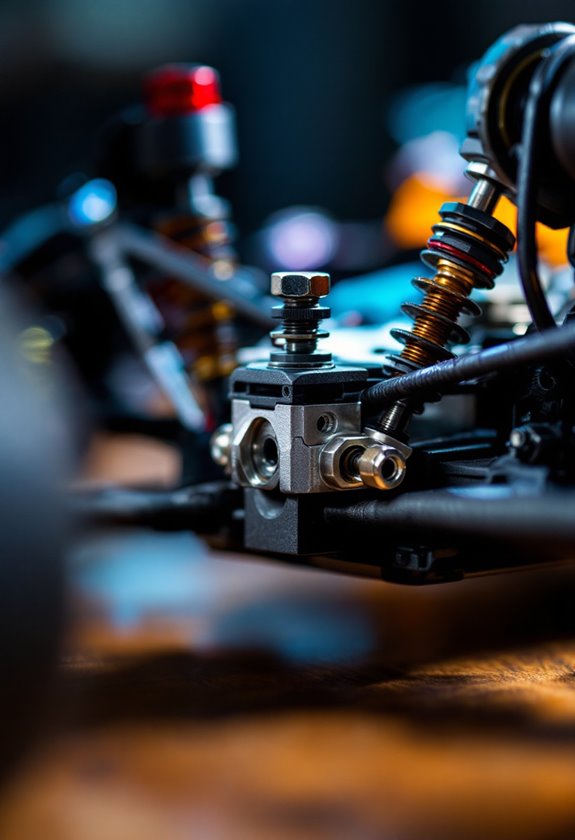
Adjusting the front toe settings of our RC car is a key component in achieving that perfect on-track performance. To fine-tune our toe angle, we’ll use the turnbuckle link adjustment system tucked between the ackerman plate and the steering knuckle. By rotating the turnbuckles, we can either shorten them for toe-out or lengthen them for toe-in. It’s essential we apply the same turns to both sides to keep everything symmetrical.
For proper alignment techniques, we can utilize the kingpin screws as reference points while checking from an overhead view. Visual estimations help us gauge our toe settings quickly. After some track testing, we’ll be able to confirm the best adjustments for our driving style. Additionally, participating in driving technique events can further enhance our understanding of how toe settings impact vehicle performance. Let’s hit the track!
Recommended Products

【Compatible with】:The RC Upgrade Parts for 1/16 Mini Slash 70054-1 RC Car
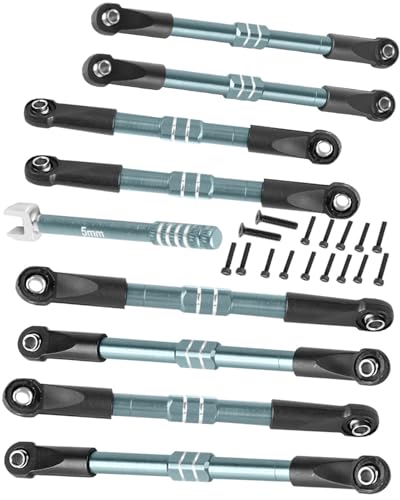
【Compatible with】:RC Turnbuckles Toe Links Upgrade Parts for 1/16 Mini E-Revo Summit Truck RC Car

RC car push rod uses highest prefect aluminium alloy material, and with delicate workmanship, making it sturdy, and long service life. And it also can help improve the performance.
Rear Toe Adjustment Techniques
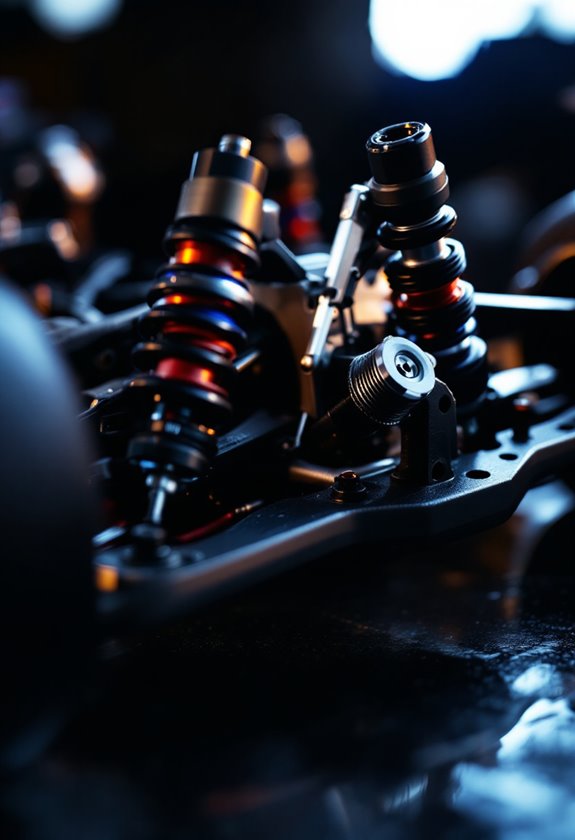
When it comes to maximizing your RC car’s performance, rear toe adjustment techniques can play a vital role. We can achieve rear toe optimization through several hardware-based methods. Utilizing adjustable components like turnbuckle links allows us to fine-tune our rear toe settings easily. For fixed configurations, we may need to swap rear arm mounts or even replace hub carriers to change toe angles effectively. Some models even feature a modular pill system for quick adjustments without tools. It’s important to remember that small changes—like half-degree adjustments—can substantially impact handling. With the right tools, including wrenches for turnbuckles, we can guarantee consistent wheel alignment, leading to a more balanced and responsive RC car. Additionally, understanding different bearing types can enhance overall performance by reducing friction and improving handling stability.
Effects of Front Toe on Handling
Understanding how front toe affects handling can make a significant difference in your RC car’s performance, especially on the track. By adjusting front toe-in, we gain advantages like increased straight-line stability, which helps with self-alignment. However, it can create a tendency for understeer, reducing our car’s responsive turn-in at corners.
On the flip side, toe-out improves our turn-in response, allowing us to corner more aggressively, but comes with disadvantages. It decreases straight-line stability, needing more steering input to initiate turns. Hence, we must carefully balance these settings. Most of us find a sweet spot, often running 1-2 degrees toe-in for stability while considering tracks that might benefit from a slight toe-out for improved corner speed. Additionally, ensuring proper alignment and installation flexibility can enhance overall vehicle performance, contributing to better handling characteristics.
Rear Toe and Its Impact on Performance
Moving from the front end of our RC car to the rear, we now focus on how rear toe impacts performance. Our rear toe dynamics can greatly influence how our car behaves on the track. When we set a higher toe-in angle, we enhance straight-line stability and traction, making it easier to accelerate out of corners. However, too much toe-in might lead to a “pushy” feeling in turns, causing understeer. On the flip side, less toe-in allows for more responsive cornering and better speed but may sacrifice some traction. It’s essential to find the right balance based on the track conditions, as the toe angle effects can make or break our race performance. Let’s fine-tune for best results!
Measuring Toe Angles
Measuring toe angles may seem intimidating, but it’s essential for optimizing your RC car’s performance. To achieve measuring accuracy, we must guarantee our vehicle is at static ride height. After dropping the car from about one foot to settle it, we can begin our measurements on a smooth, flat surface. Using techniques like the paper grid method allows us to create reference lines for comparison. Each symmetric measurement from side to side will help guide proper adjustments. For more precise calculations, smartphone apps with built-in sensors can also be a great aid. By maintaining consistent reference points, we eliminate discrepancies and enhance our overall adjustment techniques. Let’s embrace these methods and fine-tune our RC car’s setup for the best results!
Tools for Accurate Toe Measurement
When we’re fine-tuning our RC cars, the tools we use for accurate toe measurement can make a huge difference in performance. Digital gauges, like the SkyRC CTG-015, provide enhanced measurement accuracy with Bluetooth connectivity for real-time data on our smartphones. Meanwhile, mechanical tools, such as the RPM Toe-In gauge, offer a reliable distance comparison method for quick checks without removing wheels. Calibration methods guarantee these gauges maintain precision, essential during races. For complete setups, professional-grade setup stations from brands like Yeah Racing provide stable platforms and are universally compatible. Plus, portable devices bring racing convenience, allowing us to measure on the fly at any track, making sure our RC cars are always ideally aligned for the best performance.
Recommended Products

For use on most 1/10 scale rc vehicles

Material: High-quality metal construction for durability and long-term use.

Adjustable Ruler Measure RC car Height & Wheel Rim Camber,Compatible with HSP HPI Traxxas 1/10 1/8 On-road RC Car Truck,also can measure the wheelbase.
Recommended Toe Settings for RC Cars
Setting the right toe on our RC cars can greatly impact their performance and handling. For ideal setups, we generally recommend 1-2 degrees of toe-in on the front wheels for stability. If we’re running 4WD buggies, a rear toe-in of 2-3.5 degrees can help during acceleration. For speed running, zero to negative 5 degrees of front toe delivers better straight-line performance. On high-grip tracks, we should consider less toe-in to improve cornering responsiveness, while looser surfaces often need more toe-in for control. For aggressive turn-in response on technical layouts, toe-out configurations can be advantageous. Remember, tuning techniques like half-degree adjustments make a measurable difference, so let’s fine-tune our settings carefully for the best results!
Recommended Products

【Versatile Compatibility】Suitable for various RC 1/10 Scale car models including flat racing, drifting, and competitive racing cars, ensuring a universal fit for your tuning needs.

UPGRADED 4-IN-1 WHEEL ALIGNMENT KIT: Unlike basic toe alignment tools that only measure toe-in and toe-out, this advanced wheel alignment tool kit features an adjustable magnetic camber gauge to measure four essential alignment angles: camber, caster, toe-in, and toe-out. Get a more complete suspension alignment solution with one versatile tool designed for accurate vehicle alignment measurements.
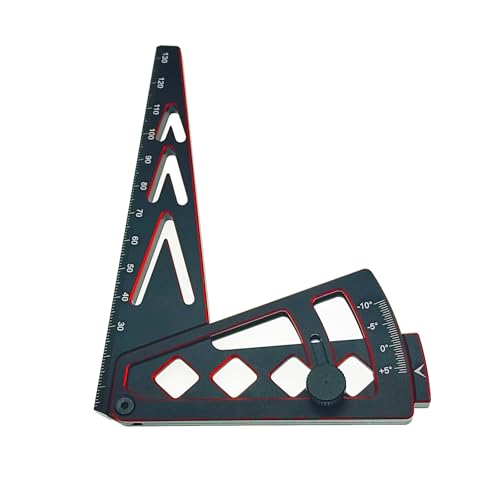
Multifunctional Design:Versatile tool for measuring rc car height and rim camber, enhancing your car maintenance and performance.
Front Toe Impact on Stability
Finding the right front toe setting can greatly enhance your RC car’s stability, especially during high-speed runs. By adjusting to 1-2 degrees of toe-in, we improve straight-line tracking, minimizing wheel wander and offering a solid performance on straightaways. However, keep in mind that increased toe-in settings can lead to an understeer tendency during turns, affecting our agility. On the other hand, toe-out decreases straight-line stability, making it harder to maintain control at higher speeds. Every time we make stability adjustments, we trade off between responsive cornering and overall stability. For ideal performance, we should consider track layout and adjust toe settings that balance these effects, giving our RC cars the edge they need in any race.
Rear Toe for Different Track Conditions
Rear toe settings can considerably influence how our RC car performs across various track conditions. On high grip tracks, we benefit from a standard rear toe-in of 2.5 to 2.75 degrees, as it balances cornering stability and responsiveness. Reducing toe-in enhances our corner speed and reduces tire wear, making our car more agile. Conversely, in low grip conditions, increasing rear toe-in to over 3 degrees provides us with better forward drive and stability under throttle. For rough tracks, extra toe-in helps maintain control over bumps. Ultimately, on smooth surfaces, reducing rear toe allows aggressive turn-in and improves lap times. By making the right rear toe adjustments, we can greatly enhance our driving experience across different terrains.
Common Mistakes in Toe Adjustments
Getting the right toe setting is just as important as knowing how to adjust it. One of the common pitfalls we face is over-adjustment. Making large leaps in toe settings can send our car into unpredictable territory, making it tough to diagnose issues. Starting with small increments, like 0.5 degrees, is key to effective adjustment strategies. We also need to thoroughly test our changes; driving the car through various scenarios helps to validate adjustments. Ignoring mechanical considerations, such as tire wear patterns, can lead to premature wear and drivetrain issues. Finally, let’s avoid blindly copying other setups, as these may not suit our unique driving style or track conditions. Taking a gradual approach guarantees better performance and handling.
Recommended Products

Six-in-one aircraft model wrench tool model car disassembly and repair tool accessories pull rod nut wrench adjustment.

Competition-Grade Alignment for 1/10 RC Buggies & On-Road Cars: 1/10 RC setup station, engineered exclusively for on-road racing cars and off-road buggies. The aluminum camber/toe gauge enables effortless adjustment of camber, toe angles, and slip angles, optimizing tire grip and steering response for maximum track performance.

Material: High-quality metal construction for durability and long-term use.
Fine-tuning Toe for Racing
When we’re racing, fine-tuning the toe settings on our RC cars can make a big difference in performance. By focusing on precise fine-tuning strategies, we can optimize our cars for the specific track conditions we face. For instance, adjusting front toe toward zero or even toe-out improves turn-in response, essential for sharp corners. Meanwhile, rear toe settings typically hover around 2.75 degrees for standard tracks, but adjusting up to 3 degrees can enhance traction and aggressive cornering. Making these competitive adjustments helps us maintain control under power, especially on challenging surfaces. By experimenting with toe settings based on track layout and grip levels, we can greatly improve overall handling and cornering balance in our racing setups.
Recommended Products

Precise Camber & Toe Adjustment: Easily measure and adjust camber and toe angles for your 1/24 or 1/28 mini RC drift cars. Fine-tuning these angles improves cornering balance, straight-line stability, and steering response — helping you achieve smoother control and faster lap times

Universal Fit – Works with most 1/10 scale rc car & 1/12 pan cars. Good rc camber gauge tool for accurate height, camber & toe measurement. Check size images for fitment.

Universal Compatibility: Designed for a wide range of popular 1/10, 1/8, and 1/7 scale RC models, this camber gauge is a versatile tool for many enthusiasts. It works seamlessly with major brands like for Traxxas, Arrma, Losi, Axial, HPI, and Redcat Racing. Whether you're tuning a high-speed buggy, a rugged crawler, or a monster truck, this tool helps you dial in the perfect setup for optimal control and traction.
Exploring Active Toe Systems in RC Cars
Active toe systems in RC cars offer an exciting evolution in vehicle handling, and they allow us to maximize our performance on different tracks. These systems leverage active toe mechanics to change the toe angle during suspension compression, creating dynamic toe adjustments. Imagine being able to tweak our car’s steering feel without being stuck with a fixed setup!
With more active toe, we get aggressive handling and less rotation through corners, perfect for tight turns. Meanwhile, less active toe increases rear grip for smooth forward motion on straights. By finely tuning our toe settings—using turnbuckles—we can adapt quickly to various track conditions. Overall, active toe systems are invaluable for maintaining optimum performance and control in any racing scenario.
How Does Temperature Affect Toe Settings in RC Cars?
Temperature variations can greatly impact tire performance, affecting grip and wear. We should monitor these changes closely, as they might necessitate adjustments to toe settings for ideal handling and stability during our RC car runs.
Can Toe Settings Impact Tire Wear Patterns?
Yes, toe settings considerably impact tire alignment and wear patterns. We’ve noticed that improper adjustments can lead to uneven tire wear, causing scrubbing and reducing the lifespan of our tires. It’s essential to get it right!
What Signs Indicate Incorrect Toe Settings?
If our car dances unnaturally in corners, we realize something’s off with our toe settings. Poor tire alignment can cause uneven tire wear and diminished steering responsiveness, alerting us to make necessary adjustments for best performance.
How Often Should Toe Settings Be Checked?
We should check toe settings regularly, especially after track conditions change or any suspension adjustments. Keeping an adjustment frequency guarantees peak performance, helping us achieve better stability and responsiveness during our runs.
Does Toe Angle Affect Battery Life in Electric RC Vehicles?
When it comes to battery efficiency, we’ve got to take into account toe angle. While it doesn’t directly affect battery life, improper settings can impact electric range, leading to more wear and tear on the battery over time.